Arthur Fouray
Arthur Fouray Index

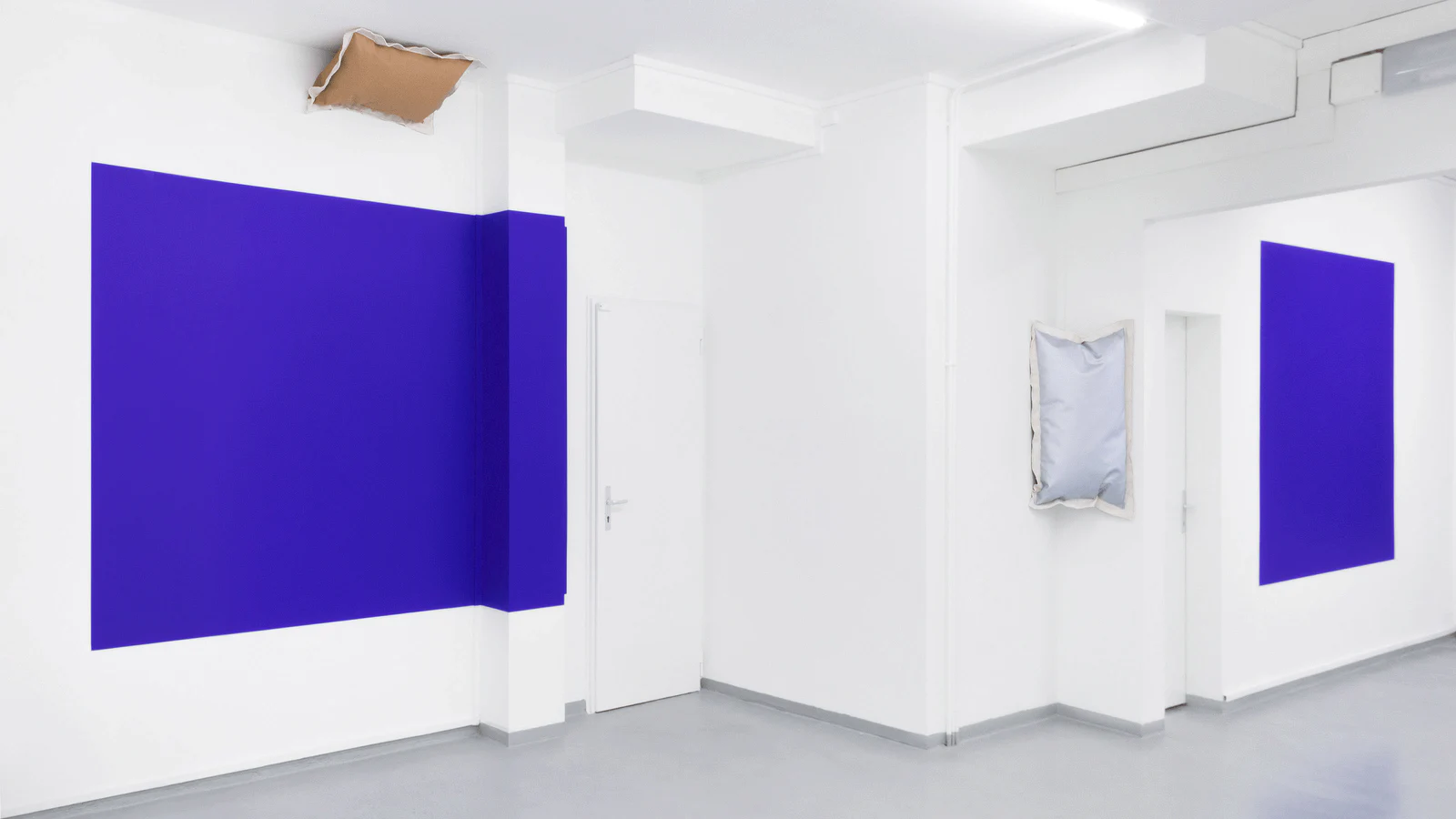
The exhibitions I made as Arthur Fouray from 2014 to 2017, in Switzerland, France, Germany and Italy: installation views, labels, credits and press. The #aaafff and #000fff series return from one show to the next, beside the pillows, bed bases, ladders and tables that served as supports for painting. A work can come back in another exhibition without coming back to the same situation. Follow the dates, or follow one object as its surroundings change.





Arthur Fouray Greffes

Greffes
Group show
Villa Medici
Rome, Italy
16.11–23.11.2017
Curator
Pier Paolo Pancotto
Photographs by Christophe de Rohan Chabot & Arthur Fouray
Special thanks to Alfredo Aceto, Paolo Caravello, Arthur Godard


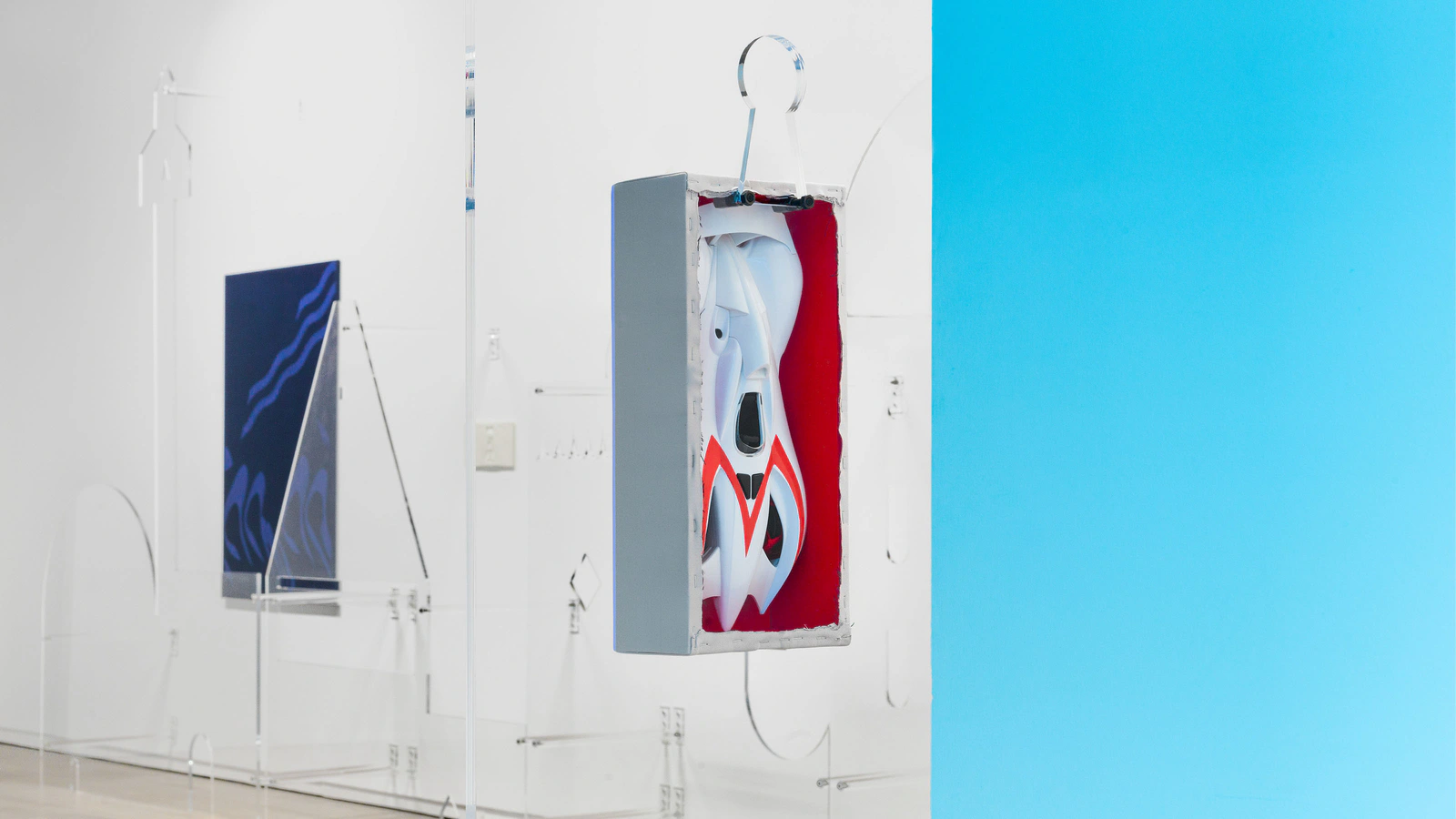
Two MDF wood boxes, both of the same size (92.5 × 40 × 10 cm), covered with a blue canvas (type ‘aaafff’).
One side (92.5 × 40 cm) displays an image or print on Dibond, laminated onto plexiglass (about 21 × 29.7 cm). It features the image of a lizard. Its eye spews blood.
The opposite side showcases a one-way mirror. Its dimensions should be slightly smaller than 92.5 × 40 cm. (…in progress…) These two boxes would thus be relatively identical objects. They are meant to be placed vertically on the floor. However, such a decision should be finalised during the installation. Also, there is a consideration if they should be displayed together or separately, either in the same room or in different spaces, and if there is an intent to make each more autonomous. At its core, through this repetitive effect, one object refers to the other, activating memory, signalling, and reminding of its twin. In the same way, a marker or a reference object sets the context in its entirety…
Christophe de Rohan Chabot & Arthur Fouray

Christophe de Rohan Chabot & Arthur Fouray
senza titolo / (X5m4mjB-1) (#aaafff)
2017
Dibond, canvas, acrylic, braces, dark glass
67.5 × 30 × 12 cm
courtesy of Gaudel de Stampa & Galerie Joy de Rouvre & the artists

Christophe de Rohan Chabot & Arthur Fouray
senza titolo / (X5m4mjB-1) (#aaafff)
2017
Dibond, canvas, acrylic, braces, dark glass
67.5 × 30 × 12 cm
courtesy of Gaudel de Stampa & Galerie Joy de Rouvre & the artists


Arthur Fouray 3 years, smart move
3 years,
smart move
Group show
Galerie Joy de Rouvre
Geneva, Switzerland
11.11–23.12.2017
Special thanks to Guillaume Maraud, Joy de Rouvre, Pierre Belloni, Frédéric Gabioud, Baker Wardlaw
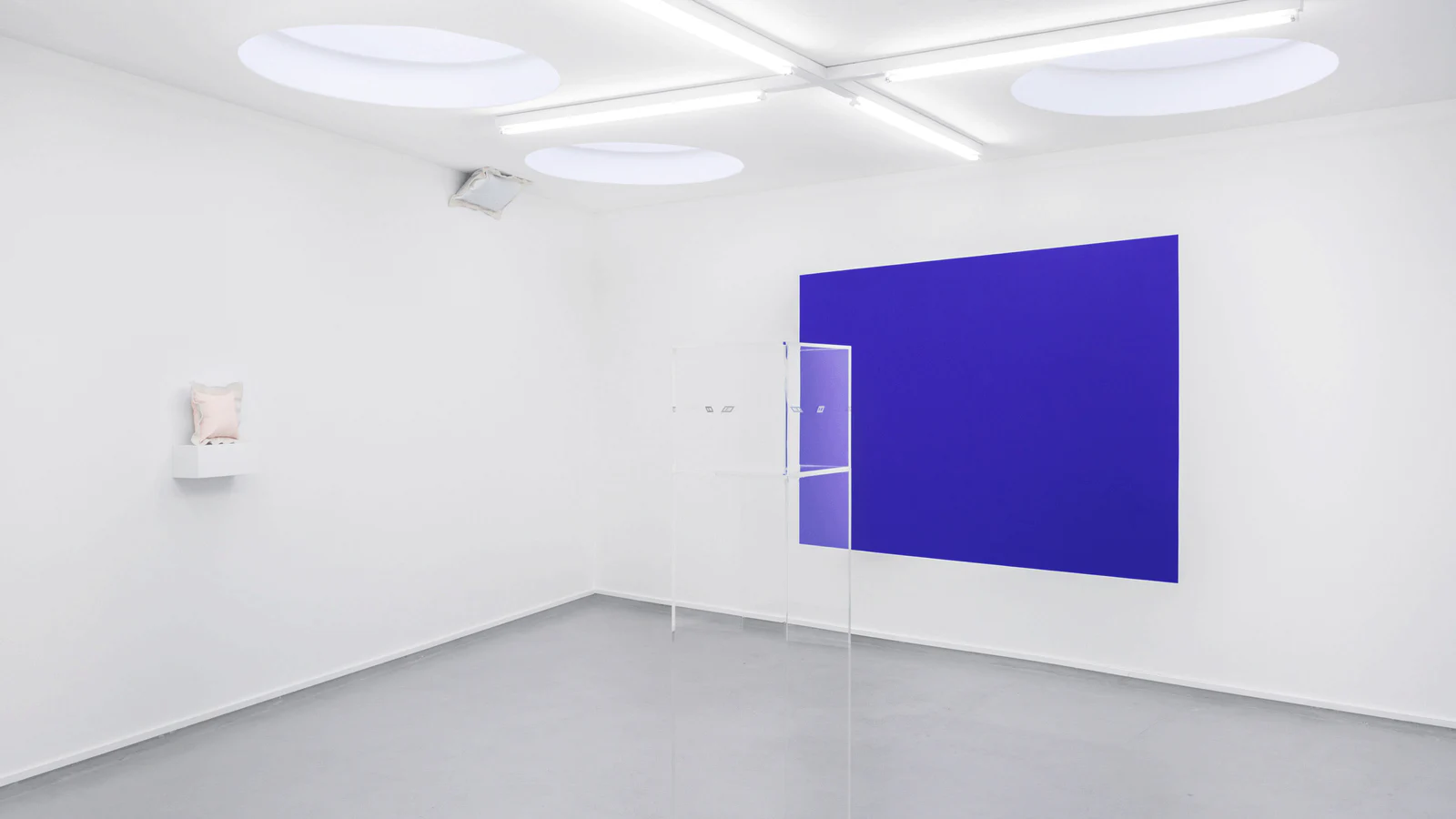
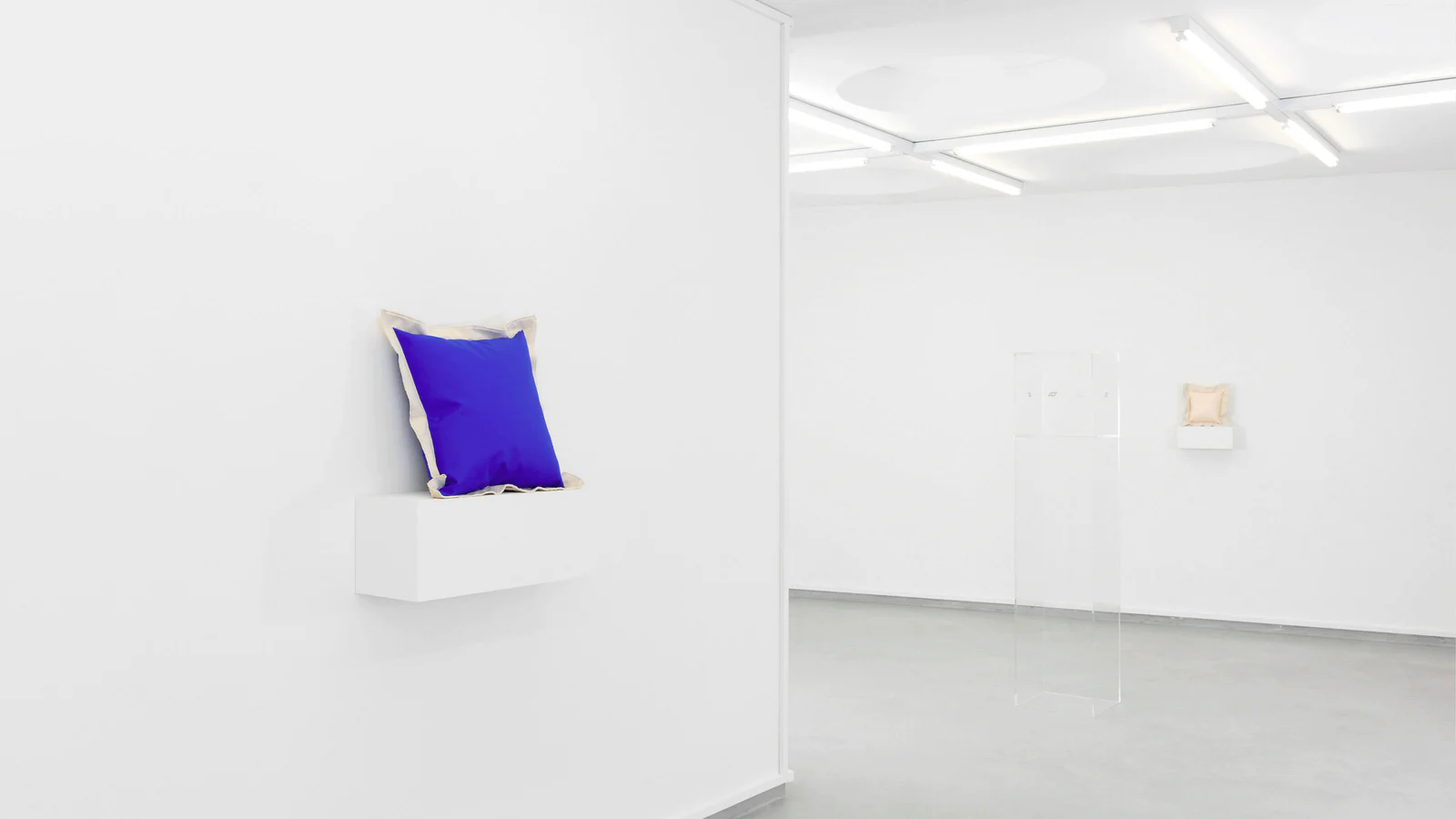
3 years, smart move was a group show at Galerie Joy de Rouvre in Geneva. It opened on Saturday 11 November 2017 and ran until 23 December. I had shown at the gallery a year earlier, in a three-person show with Frédéric Gabioud and Baker Wardlaw. At the end of 2017 the gallery began to represent my work, and did so until it closed in 2022. I showed two works. #000fff (4:3), from the #000fff series, is a wall painting in chroma-key paint, 120 × 160 cm, in the proportions of television. It was made to host a preview of Guillaume Maraud’s Sans titre, shown in Paris from 8 December 2017 to 27 January 2018. Chroma Key, Titanium (Andy) (2017) brings together four Andy (Chroma Key) and three Andy (Titanium), in acrylic and cotton duck on pillows.

#000fff (4:3) (Guillaume Maraud, Sans titre, (08.12.2017–27.01.2018, Paris, (preview)))
2017
chroma-key paint, Sans titre, (08.12.2017–27.01.2018, Paris, (preview))
120 × 160 cm
courtesy of Édouard Montassut & Galerie Joy de Rouvre & the artists


Chroma Key, Titanium (Andy)
2017
acrylic, cotton duck, pillows, 4 Andy (Chroma Key), 3 Andy (Titanium)
variable dimensions
courtesy of Galerie Joy de Rouvre & the artist


Arthur Fouray Caravan
Caravan
Solo show
Aargauer Kunsthaus
Aarau, Switzerland
26.08–12.11.2017
Curators
Yasmin Afschar
Katrin Weilenmann
Special thanks to Marielle Chabal, César Chevalier, Lauren Coullard, Marine Coullard, Philippe Decrauzat, Madeleine Schuppli, Aargauer Kunsthaus Museum Team

Invitation card
Invitation card PDF
PDF


PRESS RELEASE
Arthur Fouray (b. 1990) combines the approaches of major, opposing twentieth-century avant-garde art movements in his work: readymade, Minimal and Conceptual Art, as well as monochrome painting. He also studies current developments in-depth and it is these wide-ranging points of reference that provide the basis for his artistic concepts.


In his CARAVAN exhibition the Lausanne-trained artist places his works in the foyer of the Aargauer Kunsthaus, literally at the interface of interior and exterior space. The glass façade designed by Herzog & de Meuron is the starting point for his site-specific intervention in which he plays with the architectural situation of the foyer as well as its use as a place of encounter. The artist covers the museum’s front with curtains made of cotton that are painted bright red. This material was first used by the Abstract Expressionists in the U.S. and competed with linen canvas as the classic picture support.


Arthur Fouray’s diverse reference system is evident not just on a formal level: oftentimes the names of artists who served as inspiration for a work are, in fact, mentioned explicitly. His window installation Torres (Pyrrole) was inspired by a group of works by the Cuban artist Félix Gonzalez Torres (1957–1996). In the 1980s, Torres arranged light-blue curtains in an exhibition space; called Untitled (Loverboy), they allude to the romantic relationship of two men. For Fouray, too, the fabric panels are a means of staging. Torres (Pyrrole) is preceded by a work from the aaafff series. This combination of letters refers both to the artist’s initials and to the shade of colour featured in many of his works, which in the computer-based colour identification system used by Fouray stands for a precisely defined light violet blue. The painting shows on one side the titular colour hue, while its other side is covered by a mirror. When the visitor steps in front of the latter, the glass façade becomes a stage and the viewer becomes the protagonist of this mise-en-scène.


INTERFACE. WELCOME TO A FELIX ROOM <3: with these words in the present booklet Arthur Fouray provides the motto for his installation. He invites us into a spatial structure that is both confined and porous and in which the curtain and objects function as interfaces between two systems. Felix refers not just to the aforementioned artist, but also means ‘happy’ or ‘lucky’ in Latin. The heart icon on the back stylises this positive message.
Yasmin Afschar, Katrin Weilenmann


PRESS
Agenda — Aarau, Aargauer Kunsthaus: Arthur Fouray, 2017 – Kunstbulletin, Exhibition listing, no. 11/2017 (November 2017), p. 126; advertisement on the inside front cover – PDF · PDF
Astrid Näff, CARAVAN 3/2017 — Arthur Fouray, 2017 – Aargauer Kunsthaus, Exhibition essay on CARAVAN 3/2017, pp. 52–53, Jahresbericht 2017 – PDF · PDF
Arthur Fouray 2080


MMLXXX
Solo show
zwanzigquadratmeter
Berlin, Germany
21.05–18.06.2017
Special thanks to Éric Emery, Ascanio Cecco, Louis Ziéglé, Christophe de Rohan Chabot, Alfredo Aceto
2080 (MMLXXX) was my solo exhibition at zwanzigquadratmeter (ZQM) in Berlin, from 21 May to 18 June 2017. In the interview Eleonora Castagna published in Droste Effect on 9 June 2017, I called it ‘more a curation than a solo show’: each piece has a relationship to another artist or to specific works by other artists. The press release is the voice-over of the 1961 trailer for Last Year at Marienbad, which ends by asking the viewer to watch carefully: an object, a gesture, a decor. The wall painting #000fff (Natural Vision) (IFP), from the #000fff series, with #aaafff (existenz) re-enacts Grande Surface by IFP in chroma-key blue. #aaafff (existenz) has the size of one element of a Donald Judd stack; its unknown object, a piece of plastic washed up on a Normandy beach, lay on the floor beneath it. Opposite, nine fluorescent red Genkins hung as one piece, Genkins (Fluo) (3×3). The charcoal drawing A Brief History of Curating copies a still from Johnny Mnemonic, Robert Longo’s film. The blue wall, the green pillows and the red Genkins pinpoint three subjects: the projection, the interface and the viewer. The pillows covering the floor were silkscreened with pages of SCREEN, the catalogue of Spectre and the guide to 2080; I launched the book at Motto Berlin on 18 May. I wanted ruins on the floor. The title was meant to be read before the show: a year, a projection. Louis Ziéglé made the poster after blockbuster posters, with the works as its characters.

Louis Ziéglé
MMLXXX exhibition poster
2017


Press Release
Last Year at Marienbad
Trailer voice-over
1961
Text excerpt
A large international hotel …
… immense and baroque …
… with sumptuous but frigid decor
A stranger wanders from hall to hall …
… down endless corridors …
… in search of a woman
He tells her they met …
‘Last year …’
Try to remember,
… that they had a passionate love affair …
… that she herself set this rendezvous …
… and that he is going to take her away.
But she claims she does not know him.
Impossible, I tell you. I have never even been to Frederiksbad.
He insists, but she protests even more.
What room? I have never been in any bedroom with you
You will not remember …
… because you are afraid
And you do not recognise this photo either?
The young woman cedes ground.
The stranger – serious, confident – gathers more and more proof.
Who is right? Who is lying?
Is he a mere seducer? A madman?
Or has he just confused two faces?
What really happened ‘last year’?
You, the viewer, must answer these questions.
Watch carefully:
… an object …
… a gesture …
… a decor …

#000fff (Natural Vision) (IFP)
2017
chroma-key blue, wall painting, #aaafff (existenz)
A/R 1.85
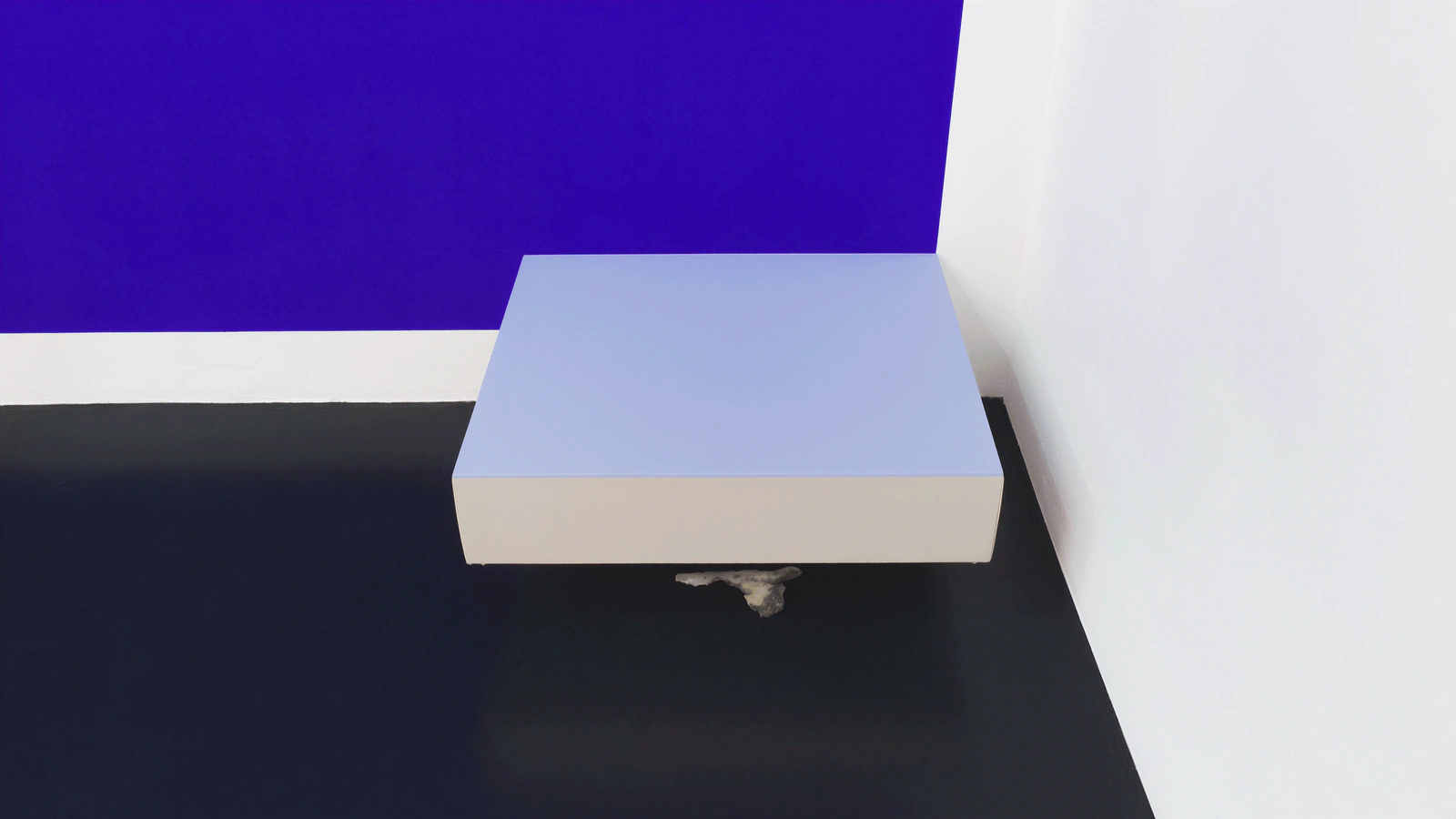

#aaafff (existenz)
2017
acrylic, blackout fabric, unknown object
69 × 61 × 15 cm
Courtesy of the artist

Genkins (Fluo) (3×3)
2017
acrylic, cotton duck
220 × 185 × 15 cm
Courtesy of the artist

A Brief History of Curating
2017
charcoal, Arches paper, cardboard
15 × 21 × 3 cm
Courtesy of the artist


PRESS
Eleonora Castagna, Arthur Fouray’s ‘2080’ at ZQM in Berlin, 2017 – Droste Effect Magazine, Interview, 9 June 2017 – drosteeffectmag.com · PDF
Twin Peaks
https://www.youtube.com/embed/72hIy_Ktx9M
Twin Peaks, 2017. Arthur Fouray. Single-channel video with sound · 1 min 43 sec.
A white disc turns against a blue field, and a small green point interrupts it, inside a frame that never moves.
The blue is my wall painting #000fff (Veriscope), painted in chroma-key blue, the colour a studio replaces with another picture; here I filmed it and left it in place. The green point is ç (#aaafff (B.A.A.)), a leather-and-screw object of 1 × 1 × 1 cm. The turning disc is Portmanteau Rotary Plate, as my portfolio Arthur Fouray 2015–2017 names it. Inside the video the painting and the objects change scale: the wall becomes a field of colour, the small object a point, the rotary plate a moving disc.
I set the video to Richard Strauss’s Also sprach Zarathustra, Op. 30 – Prelude, written in 1896 after Friedrich Nietzsche’s book; since Stanley Kubrick’s 2001: A Space Odyssey (1968), its opening carries the film with it.
Sources: Arthur Fouray, Catalogue, 2017; Arthur Fouray 2015–2017, p. 7.
Further reading: Richard Strauss – orchestral works.
Frédéric Gabioud Arthur Fouray Baker Wardlaw
Frédéric Gabioud, Arthur Fouray, Baker Wardlaw
Three-person show
Galerie Joy de Rouvre
Geneva, Switzerland
12.11–19.11.2016
Special thanks to Pierre Belloni, Joy de Rouvre, Baker Wardlaw, Frédéric Gabioud
Frédéric Gabioud, Arthur Fouray and Baker Wardlaw showed together at Galerie Joy de Rouvre in Geneva from 12 to 19 November 2016. Frédéric and I had founded Silicon Malley, an artist-run space in Prilly, in 2015, with Grégoire Bolay, Julien Fischer and Paul Limoujoux; Baker joined us later. I showed five works. Two come from the #aaafff series: #aaafff (CAR), acrylic and blackout fabric with a Shark truck, and #aaafff (Uber Eats), with kraft paper and Uber Eats bags. The other three are acrylic on cotton duck over an object: Kasimir I on a pillow, C/O ( ))) ))) ) on a bench, with letrAVision, and C/O (Eve Kendall) on a table.
#aaafff (CAR)
2013–2017
acrylic, blackout fabric, Shark truck
16 × 16 × 4 cm
Courtesy of the artist


#aaafff (Uber Eats)
2016
acrylic, blackout fabric, kraft paper, Uber Eats bags
35 × 45 × 10 cm
Courtesy of the artist

Kasimir I
2016
acrylic, cotton duck, pillow
58 × 58 × 20 cm
Courtesy of the artist

C/O ( ))) ))) )
2016
letrAVision, acrylic, cotton duck, bench
50 × 250 × 40 cm
Courtesy of the artist

C/O (Eve Kendall)
2016
acrylic, cotton duck, table
118 × 88 × 72 cm
Courtesy of the artist
Arthur Fouray Kiefer Hablitzel Prize
Kiefer Hablitzel Prize
Group show
Swiss Art Awards
Basel, Switzerland
14.06–19.06.2016
Opening 13.06.2016
Photographs by Julien Gremaud
Special thanks to Alfredo Aceto, Alain Fouray, Béatrice Fouray, Léa Fluck, Julien Gremaud, Stéphanie Serra
In 2016 I was nominated for the Kiefer Hablitzel Prize and showed four works at the Swiss Art Awards in Basel. #aaafff (autruche) is an ostrich-feather duster inside a canvas of acrylic and blackout fabric. Kasimir I is acrylic and cotton duck on a pillow; it was shown with #000fff (univision) (Kasimir I), a wall painting from the #000fff series, in which I use the hexadecimal colour #000fff, a pure screen blue. Morel (P.A.S., C.B.S.F.T.) is one of the Morel boxes, made of painting stretchers, where I keep the tests and attempts in my work; the name comes from Bioy Casares’s The Invention of Morel.


#aaafff (autruche)
2016
acrylic, blackout fabric, duster
85 × 23 × 15 cm
Courtesy of the artist

#000fff (univision) (Kasimir I)
2016
chroma-key blue, wall painting, Kasimir I
A/R 2

Kasimir I
2016
acrylic, cotton duck, pillow
58 × 58 × 20 cm
Courtesy of the artist


Morel (P.A.S., C.B.S.F.T.)
2016
cotton duck, frames, P.A.S., Carré Blanc Sur Fond Toile
145 × 85 × 12.5 cm
Courtesy of the artist


Arthur Fouray Les Lèvres nues

Les Lèvres nues
Group show
DOC!
Paris, France
16.04–30.04.2016
Opening 15.04.2016, 6 p.m.
Curators
Noémie Vulpian
Jarry (César Chevalier)
Artists
Katinka Bock
César Chevalier
Isabelle Cornaro
Fabien Danesi
Antonin Fassio
Arthur Fouray
Gaillard & Claude
Daiga Grantina
Marcel Mariën
Xavier Mary
Loup Sarion
Quotations selected by Fabien Danesi from the journal Les Lèvres nues, 12 issues, 1954–1958
Special thanks to César Chevalier, Noémie Vulpian, Antonin Fassio, Jeremy Guinoiseau
Press release
PDF
Les Lèvres nues was a group exhibition at DOC! in Paris, from 16 to 30 April 2016, on a proposal by Noémie Vulpian and Jarry (César Chevalier). It shares its title with the journal Les Lèvres nues (twelve issues, 1954–1958), from which Fabien Danesi selected quotations; the artists included Katinka Bock, Isabelle Cornaro and Marcel Mariën. I showed two works. Lauren (#aaafff), acrylic and cotton duck on a bed base, was placed between César Chevalier’s Exotica (1984) and Isabelle Cornaro’s Reproductions (variantes); Rrose (DOC) is acrylic and jute fabric on a pillow. That year I joined DOC! as one of its curators.

Lauren (#aaafff)
2016
acrylic, cotton duck, bed base
135 × 190 × 20 cm
Courtesy of the artist

Rrose (DOC)
2016
acrylic, jute fabric, pillow
60 × 45 × 20 cm
Private collection


Arthur Fouray Accrochage Vaud
Accrochage Vaud
Group show
MCBA
Lausanne, Switzerland
22.01–06.03.2016
Special thanks to Anaïs Defago, Damián Navarro, Frédéric Gabioud, Jacques Duboux
Accrochage Vaud was a group exhibition at the MCBA in Lausanne, from 22 January to 6 March 2016. I showed two paintings from that year side by side, MC (Baby blue) and FG (Océan), both in acrylic and cotton duck on a ladder, 40 cm wide and 240 or 200 cm high. I had already used a ladder in MC (Taupe), a piece from 2014 shown at BOOM in 2015.

MC (Baby blue)
2016
acrylic, cotton duck, ladder
40 × 240 × 6 cm
Courtesy of the artist

FG (Océan)
2016
acrylic, cotton duck, ladder
40 × 200 × 6 cm
Courtesy of the artist
Arthur Fouray Osmosis, Lauren (Azur), Kasimir (Ciel), Morris (Saphir), #aaafff (cendrier)


Osmosis, Lauren (Azur), Kasimir (Ciel), Morris (Saphir), #aaafff (cendrier)
Solo show
La Placette
Lausanne, Switzerland
20.11–18.12.2015
Special thanks to Camille Lichtenstern, Niels Wehrspann, Lorraine Pidoux, Julien Gremaud, Darren Roshier
Osmosis was my solo exhibition at La Placette, Lausanne, from 20 November to 18 December 2015. It opened a week after my first solo show, Spectre, in Geneva, and the two ran at the same time. The title is shared with a small gouache on Arches paper and cardboard. Lauren (Azur), Kasimir (Ciel) and Morris (Saphir) are acrylic and cotton duck on a bed base, a pillow and a duvet. Each title names the piece’s starting point, a first name, and its colour in brackets. #aaafff (Cendrier), from the #aaafff series, is made with an ashtray and blackout fabric.

Osmosis
2015
gouache, Arches paper, cardboard
23.5 × 17 × 1.2 cm
Private collection

Lauren (Azur)
2013–2014
acrylic, cotton duck, bed base
124 × 204 × 14 cm
Courtesy of the artist

Kasimir (Ciel)
2014
acrylic, cotton duck, pillow
52 × 52 × 17 cm
Private collection

Morris (Saphir)
2014
acrylic, cotton duck, duvet
200 × 140 × 32 cm
Courtesy of the artist

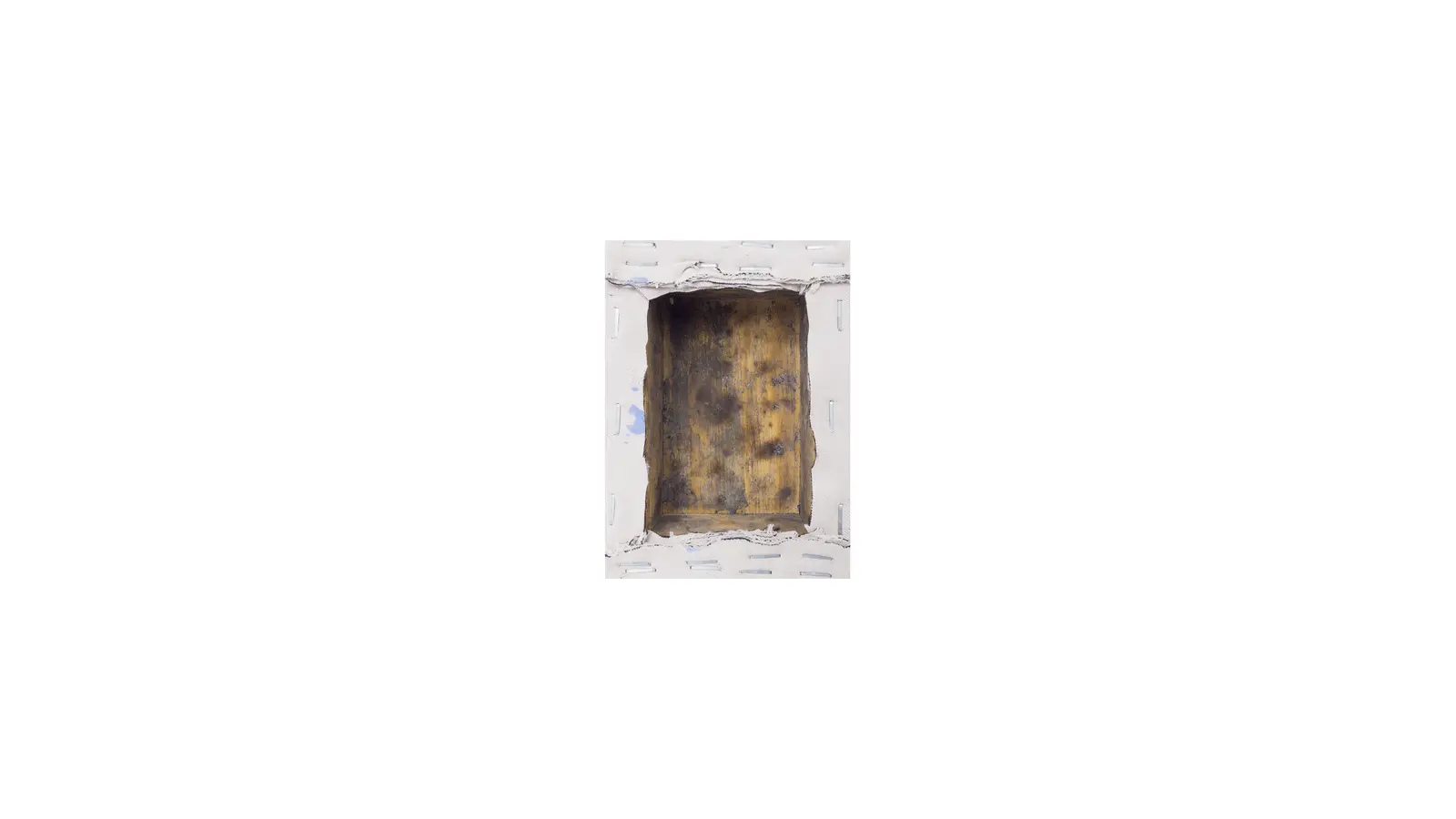
#aaafff (Cendrier)
2013–2014
acrylic, blackout fabric, ashtray
9.2 × 12.8 × 6.4 cm
Private collection


Arthur Fouray Spectre

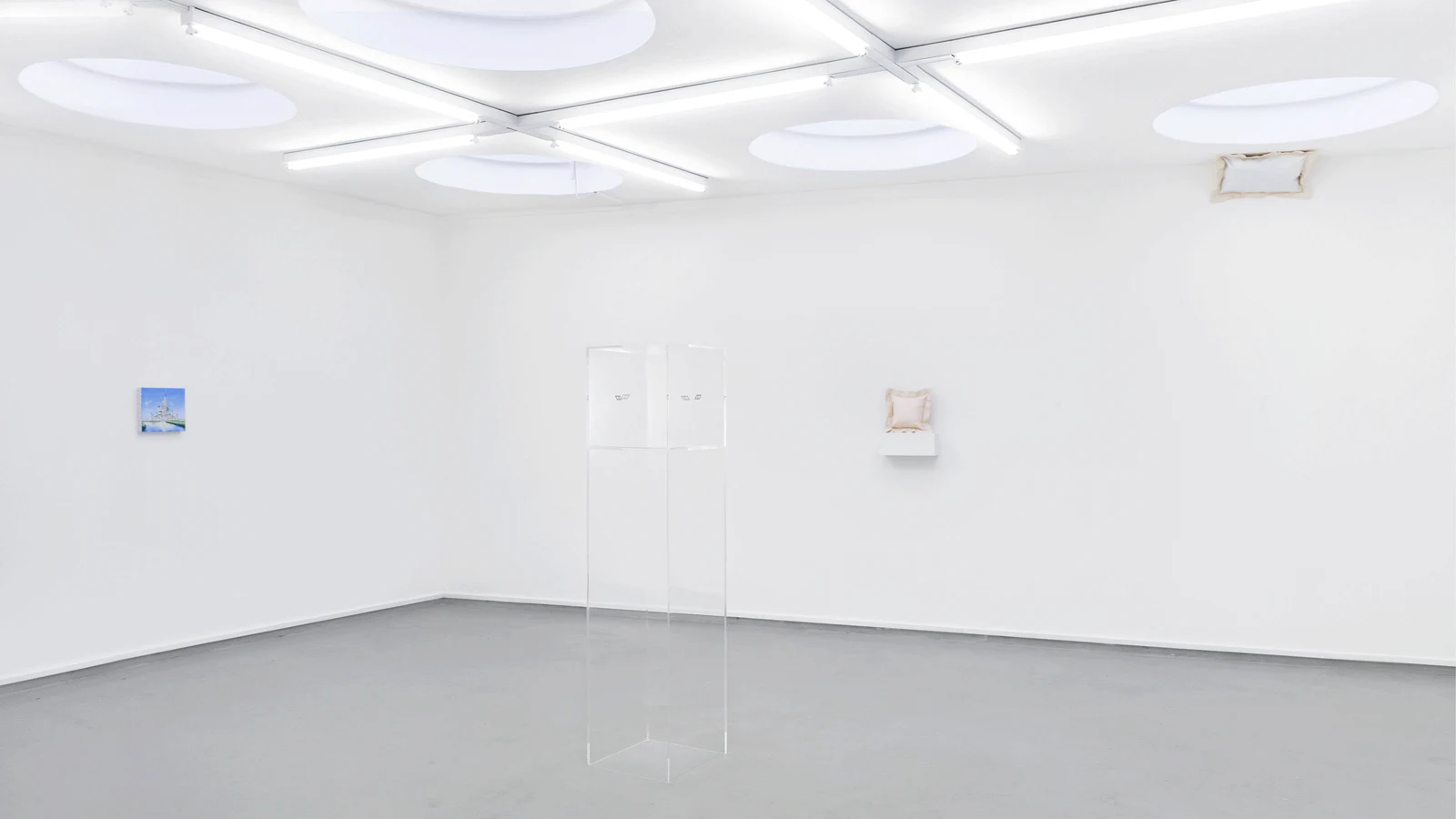
Spectre
Solo show
Espace Quark
Geneva, Switzerland
13.11–21.12.2015
Opening 12.11.2015
Curator
Elisa Langlois
Photographs by Annik Wetter and Arthur Fouray
Special thanks to Elisa Langlois, Nastassia Montel, Jean-Marie Bolay, Julien Gremaud, Stéphanie Serra, Frédéric Gabioud, Grégoire Bolay, Baker Wardlaw, Boesner France, BFP-CINDAR
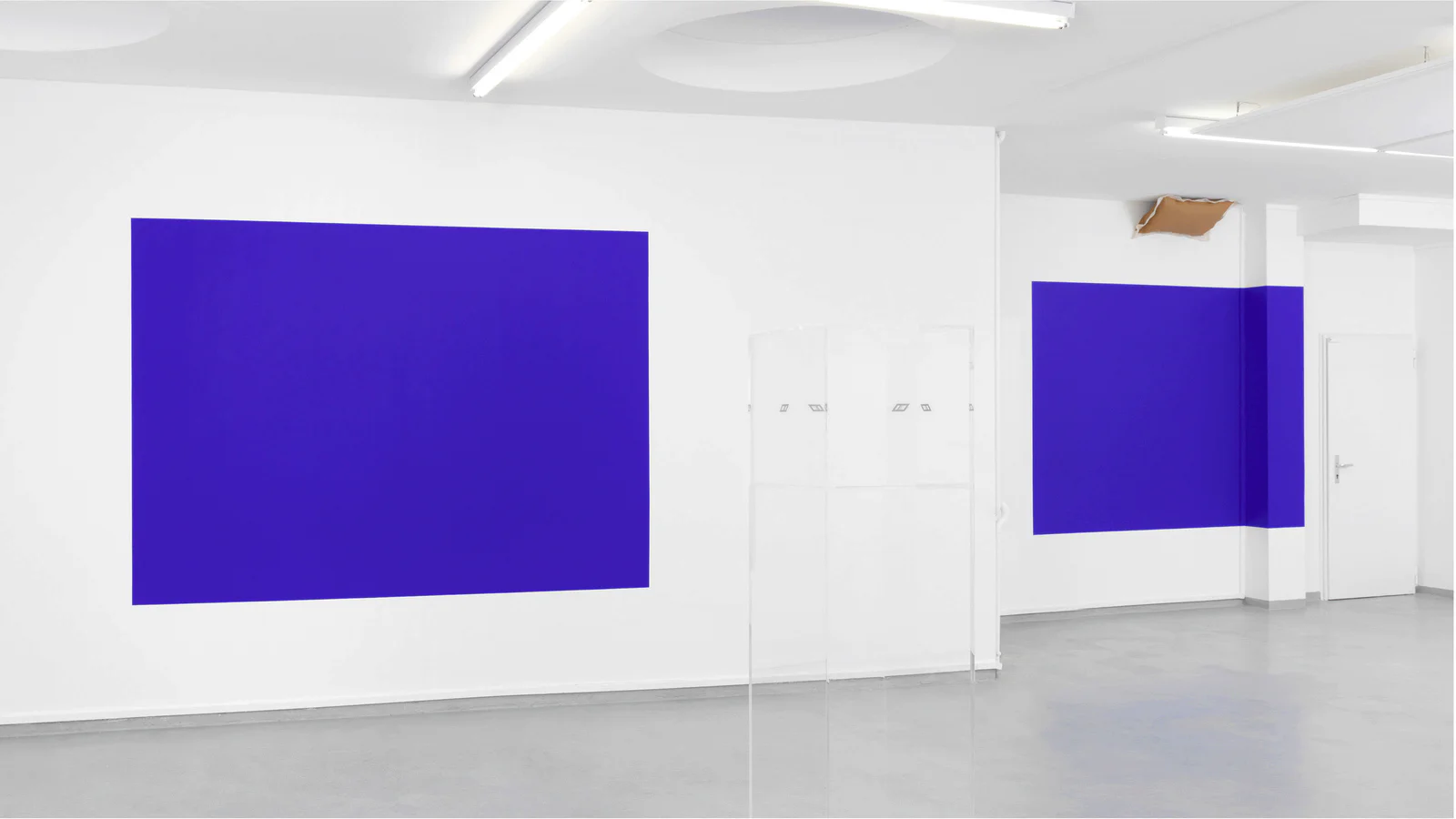
Press Release
Arthur Fouray is a story in the making. It begins with a ‘Once upon a time’ and unfolds through recurring figures of speech that shape the content of what he says. From historical fresco to modern painting, Arthur Fouray questions history and stories by taking Pop detours such as the cinema screen or Walt Disney. Spectre is a first solo exhibition. It is a genuine opening proposal. A kind of teaser for what awaits us in the further adventures of this young artist. It lays the foundations of a cosmogony whose dynamic stakes take material form in type-objects. These come in series and weave links with one another to form a cohesive statement whose profiles are shaped through the prism of different spectres.
Finely chosen colours, perfect flat areas, well-defined painted surfaces: Arthur Fouray practises the monochrome with care and precision. If the monochrome is a historical pictorial form in the twenty-first century, with its Suprematist, spiritual and geometric figures – if the monochrome is a degree zero of painting, a simple, radical or essential gesture, with Arthur Fouray it takes on, beyond its referential dimension, an autographic and signalling dimension.

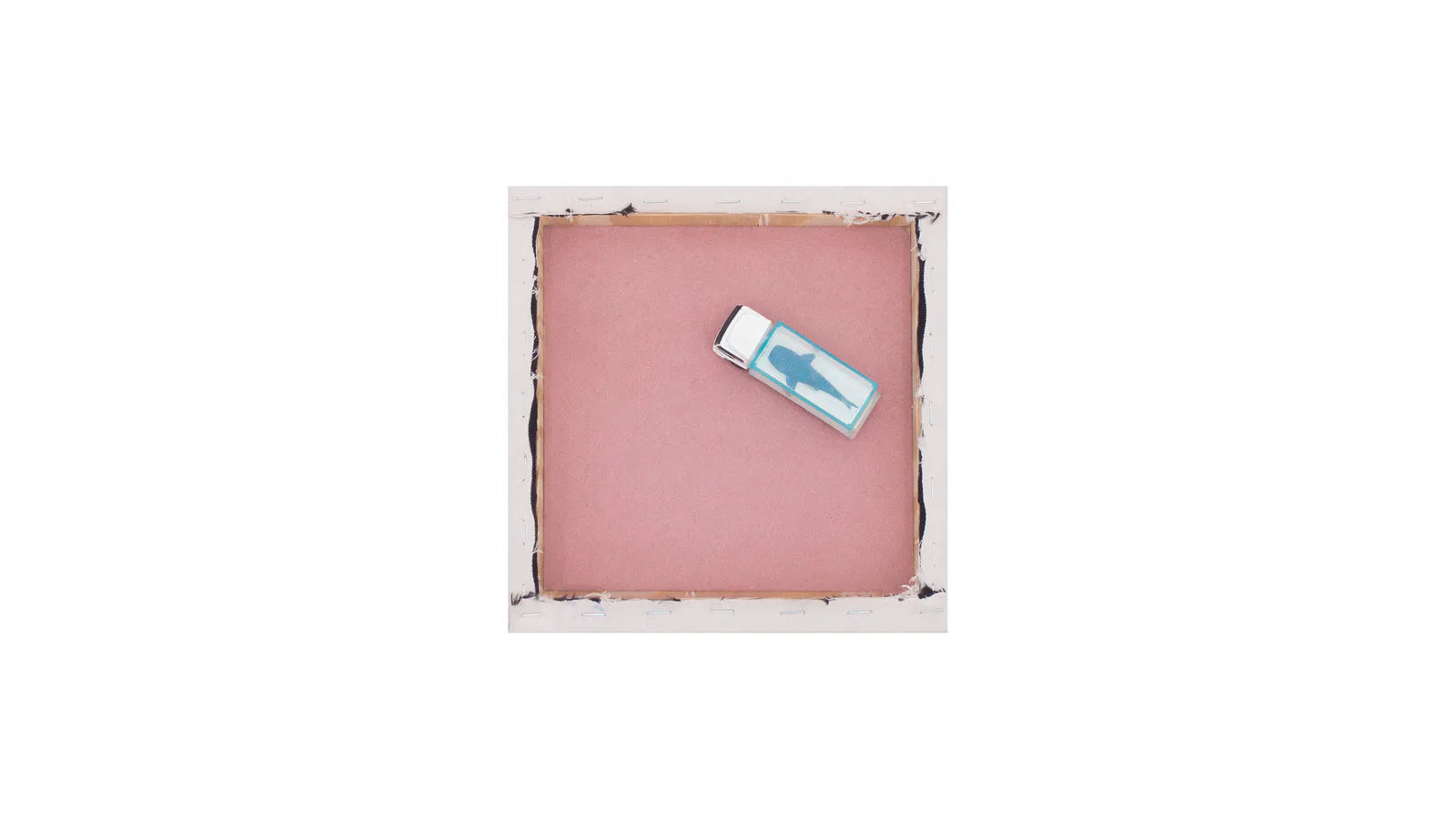
#aaafff (CAR)
2013–2017
acrylic, blackout fabric, Shark truck
16 × 16 × 4 cm
Courtesy of the artist
The #aaafff series of paintings works according to a clearly defined formula. These monochromes, in a shade halfway between sky blue and mauve, hide an object within their stretchers, most often one taken from the domestic environment. The colour indicates the nature of the piece, a nested work that joins a monochrome canvas to an object. Here the artist reconciles abstraction and the ready-made, two pillars of the history of the avant-garde that are, on the face of it, antagonistic. Through the play of the series, the #aaafff works present themselves as the stamp of this approach. A code that signals a specific gesture, a hybrid of painting and sculpture.

#000fff (polyvision) (Spectre)
2015
chroma-key blue, wall painting, Spectre
A/R 4 (1.33 × 3)
In the case of #000fff polyvision, Spectre proposes a variant of the rule. #000fff polyvision is a mural painting at the maximum saturation of the colour #aaafff. The work no longer hides an object but suggests its projection. The dimensions of the piece take up the ratios of the triptych polyvision screen used by Abel Gance for his film Napoléon, 1927. It is a utopian and gigantic cinematic form, a triple colour projection on three joined screens. Gance deliberately borrowed the term triptych from painting to signify the shift of medium carried out by the historical fresco towards cinema. #000fff polyvision shifts the genre once again, from the screen to painting.
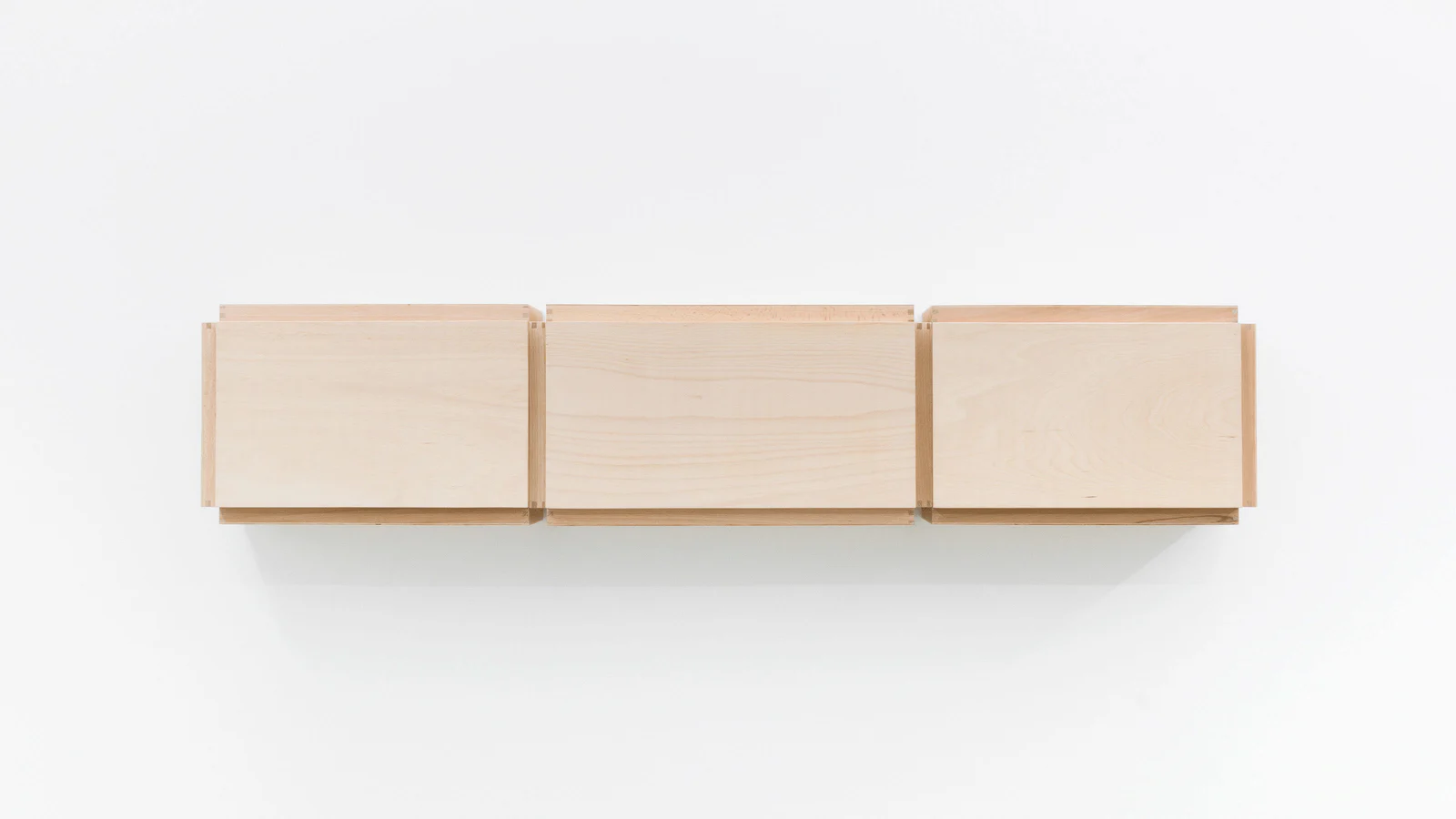
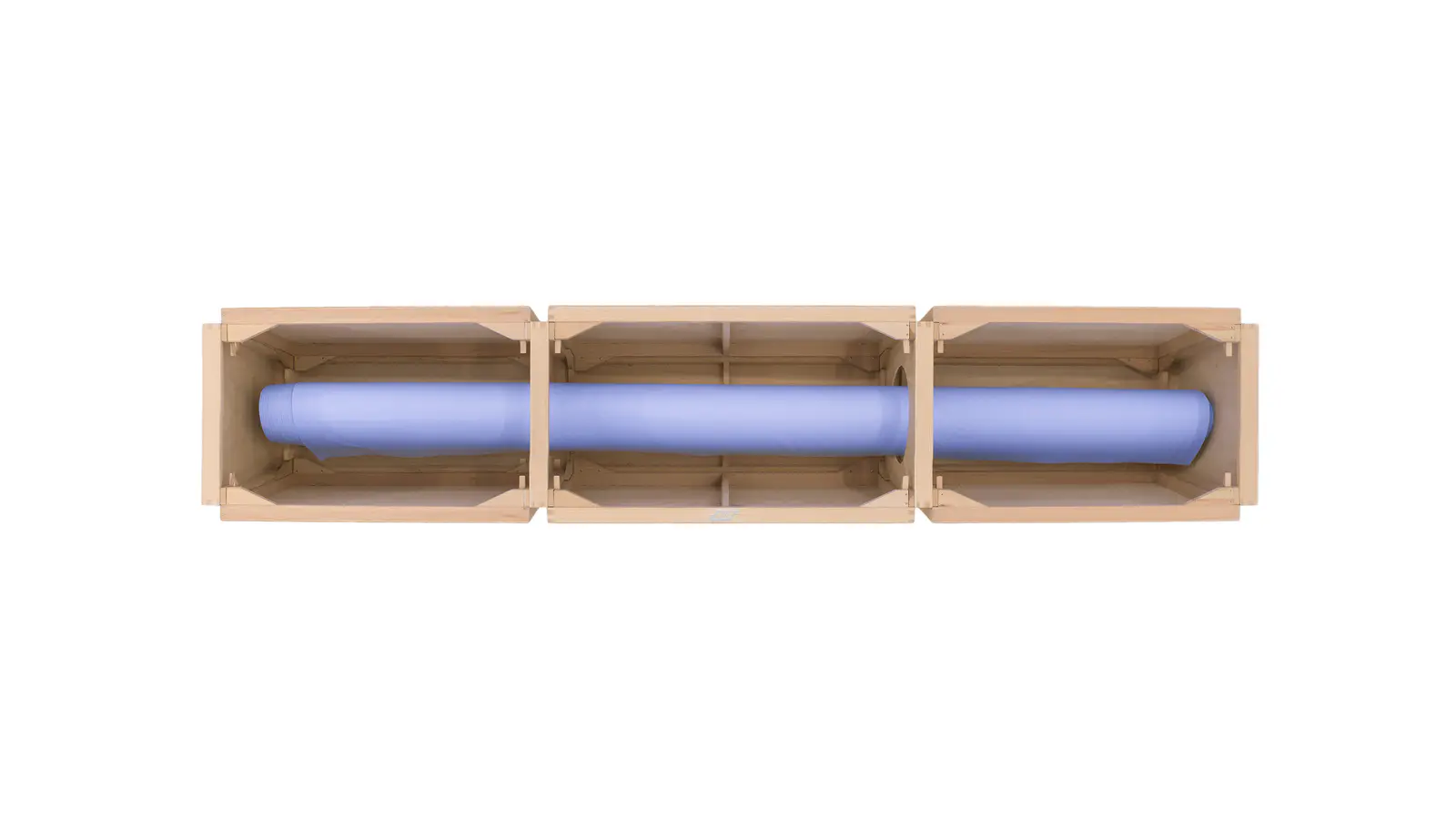
Morel (#aaafff polyvision)
2015
frame, key frames, #aaafff polyvision
172 × 36 × 32 cm
Courtesy of the artist
Combining the architectural and the experimental, Morel #aaafff polyvision comes from a series parallel to the #aaafff. In Morel #aaafff polyvision, a painting is held rolled up in a case. It is a monochrome canvas 16 metres long that the artist decided to fix as it is within the sculpture: ‘a fossilisation of the object within a medium’. Beyond its role as a container, the case is in itself a complex object with its own narrative. The structure is made of 12 ready-made boxes originally intended for painting. While it recalls the wood panelling of the princely galleries of the seventeenth century, its arrangement on the wall echoes the ‘specific objects’ of Donald Judd, notably the series Untitled (Ballantine 89–49), modular wooden boxes placed horizontally on the wall.
In these two works, from the ‘Grand Siècle’ to Minimal art, from history painting to the screen, the anachronistic and conceptual gaps they perform are marked by the spectre of Marcel Broodthaers. Broodthaers is a recurring figure in Arthur Fouray’s lexicon of references, because he perfectly illustrates a search for balance and meaning in the forced unions of the pair Official Art – Critical Art.

Andy III
2015
acrylic, cotton duck, pillow
60 × 42 × 12 cm
Private collection

Kasimir (Signal Blue)
2015
acrylic, cotton duck, pillow
58 × 58 × 9 cm
Courtesy of the artist

Andy IV
2014
acrylic, cotton duck, pillow
60 × 100 × 25 cm
Courtesy of the artist

Kasimir (Blush)
2015
acrylic, cotton duck, pillow
27 × 27 × 8 cm
Courtesy of the artist

Andy (Caramel)
2014
acrylic, cotton duck, pillow
72 × 36 × 24 cm
Courtesy of the artist
Andy and Kasimir are the protagonists of the ‘canvas-objects’ series. The series began in 2013, when Arthur Fouray decided to stretch a canvas over the base of his bed. Like the #aaafff, the canvas-objects are all monochrome. Here the unifying gesture is the use of bedding as stretchers. Through the prism of the domestic and the intimate, from pillow to duvet, the canvas-objects engage the monochrome in an evident relation to the body. Their titles shed light, through their clues, on the referential content of the object, linking it to a colour or a number. In a gesture almost more Pop than Minimal, this series brings out a porosity of genres. If Kasimir pulls on the Malevich elastic, the object it presents absolves the monochrome of its Suprematist myth, that of a ‘pure’ and self-sufficient abstract painting. Just as Andy clearly refers to Warhol’s Silver Clouds, the airy lightness of the Pop helium balloons lies down beneath the canvas and the paint. By bringing a domestic structure into his canvases, Arthur Fouray turns the degree zero of painting inside out.
Elisa Langlois

L’Époque et son style
2015–2017
gouache, Arches paper, cardboard
26.5 × 26 × 4 cm
Courtesy of the artist


Arthur Fouray Master of Arts HES-SO in Fine Arts
Master of Arts HES-SO in Fine Arts
Diploma
écal
Renens, Switzerland
2015
Photographs by Julien Gremaud and Arthur Fouray
Special thanks to Nastassia Montel, Stéphane Dafflon, Antoine Prokos, Frédéric Gabioud, Pierre Girardin
I completed the Master of Arts HES-SO in Fine Arts at ECAL in Renens in June 2015, in the programme directed by Stéphanie Moisdon. For the diploma I showed three works, from left to right: Andy IV, acrylic and cotton duck on a large pillow; #aaafff (STUDIO MODERNES), from the #aaafff series, acrylic and blackout fabric with towels; and Hélio (Noir Cendré), acrylic and cotton duck on a baby duvet.

Andy IV
2014
acrylic, cotton duck, pillow
60 × 100 × 25 cm
Courtesy of the artist

#aaafff (STUDIO MODERNES)
2015
acrylic, blackout fabric, towels
72 × 9 × 12 cm
Courtesy of the artist

Hélio (Noir Cendré)
2014
acrylic, cotton duck, baby duvet
120 × 90 × 15 cm
Courtesy of the artist


Arthur Fouray Life is a Bed of Roses, (un roman)

Life is a Bed of Roses, (un roman)
Group show
Fondation d’entreprise Ricard
Paris, France
27.05–04.07.2015
Curator
Stéphanie Moisdon
Special thanks to Jean Bourgois
Life is a Bed of Roses (un roman) was a group exhibition conceived by Stéphanie Moisdon at the Fondation d’entreprise Ricard, Paris, from 27 May to 4 July 2015, the year I completed the Master she directed at ECAL. It took shape over a year of workshops, around a film by Alain Resnais. I showed #aaafff (Mach 6), 2014–2015, from the #aaafff series: acrylic and blackout fabric with a Mach 6, the car from the film Speed Racer. To me, Speed Racer is the story of a small company run by caring people who work together to build a racing car. The piece is now in a private collection.


#aaafff (Mach 6)
2014–2015
acrylic, blackout fabric, Mach 6 car (Speed Racer)
20 × 44 × 12.5 cm
Private collection


PRESS
Life is a Bed of Roses (un roman), Fondation d’entreprise Ricard, Paris – group exhibition listing (conceived by Stéphanie Moisdon), 2015 – Paris Art, 22 May 2015 – paris-art.com · PDF
Arthur Fouray BOOM
BOOM
ECAL
Renens, Switzerland
21.01–22.01.2015
Special thanks to Nicolas Degrange, Marine Julié
I showed four works under the title BOOM in Half Time, a group exhibition at ECAL in Renens on 21 and 22 January 2015: Kasimir (Rose Pâle), acrylic and cotton duck on a pillow; #aaafff (Mur Grec), from the #aaafff series, acrylic and blackout fabric with lime and dispersion paint; a small gouache on Arches paper and cardboard, listed as Elizabeth Taylor in my 2016 captions; and MC (Taupe), acrylic and cotton duck on a ladder. My interest in Elizabeth Taylor began with Warhol’s POPism, where he writes about Boom, her 1968 film of Tennessee Williams’s play The Milk Train Doesn’t Stop Here Anymore.

Kasimir (Rose Pâle)
2014
acrylic, cotton duck, pillow
35 × 35 × 12 cm
Courtesy of the artist


#aaafff (Mur Grec)
2014–2015
acrylic, blackout fabric, lime, dispersion paint
36 × 58 × 4.5 cm
Private collection

The Milk Train Doesn’t Stop Here Anymore
2015–2017
gouache, Arches paper, cardboard
13.5 × 9.2 × 1 cm
Courtesy of the artist

MC (Taupe)
2014
acrylic, cotton duck, ladder
39 × 244 × 6 cm
Courtesy of the artist
Arthur Fouray Synallagma Show
Synallagma Show
Group show
Espace Quark
Geneva, Switzerland
04.12.2014–11.01.2015
Curator
Elisa Langlois
Special thanks to Elisa Langlois, Paul Limoujoux, Philippe Decrauzat
Synallagma Show was a group exhibition curated by Elisa Langlois at Espace Quark, Geneva, from 4 December 2014 to 11 January 2015. I showed #aaafff (B.A.A.), also titled #aaafff (Bande Adhésive Antidérapante), a piece from the #aaafff series. Each of these canvases, in acrylic and blackout fabric, contains an object that it does not show; the colour, the hexadecimal web code #aaafff, stands for my initials, AF. Each piece rests on the same loop: canvas and colour, then the invisible object, then the label, which tells what the object is. Elisa Langlois went on to curate Spectre, my first solo exhibition, at Quark in 2015.


#aaafff (B.A.A.)
2014
acrylic, blackout fabric, adhesive grip tape
34 × 34 × 3.5 cm
Private collection
Arthur Fouray #aaafff
#AAAFFF
Each #aaafff painting holds an object inside its frame. You face a monochrome, and its title names what is behind it. Looking more closely will not close the distance between the two. The series began in 2014, on frames I had built in 2013, and every work in it has followed the same loop, which I called its theoretical basis: a canvas and a colour, then an invisible object, then a label.
The hexadecimal code #aaafff holds my initials, A and F. I mix the colour by eye from a screen, with fluorescent pink, cobalt blue and titanium white, so the code stays exact while the paint varies from one surface to the next. In April 2015 I meant to sign every piece with it: a print of my right index finger dipped in #aaafff.
Blackout fabric blocks the light. Stretched like a canvas over a found object, or wrapped round it, it gives the object a painted front. In 2014 I wrote that the series reverses classical mysticism, to make a mystery that is concrete and physical.
Rectangles and tondos take their depth from what they contain: towels in STUDIO MODERNES, an ashtray in Cendrier, an ostrich-feather duster in autruche, a toy shark truck in CAR, whose frame dates from 2013 and whose canvas I restretched in 2017. Titles, dimensions and material lists give clues; none of them shows the object. One canvas was opened in 2015 and gave back a replica Star Wars medal; another held L’invention de Morel. The rest stay closed, and the label remains the place where an unseen thing is made public.
From one work to the next the colour’s code stays the same and the object changes. I keep the object; its image belongs to whoever imagines it.
#000FFF
Resize window
Chronophotographe
Developer: Étienne-Jules Marey · 1888
1:1 · camera
Details [2]
Camera: 90 mm / 1.00 / 3.543" × 3.543" / unperforated / spherical
Projection: – / – / – / –
First work: motion analysis studies
The archive describes unperforated 90, 60 and 35 mm Marey strips. Camera studies are not asserted to have a theatrical projection standard.
Paper film
Developer: Louis Le Prince · 1888
1:1
1:1 · cameraDetails
Camera: 65 mm / 1.00 / – / unperforated / spherical
Projection: not known / 1.00 / – / spherical
First work: Roundhay Garden Scene
Machine Camera
Developer: William Friese-Greene · 1889
1:1 · camera
Details
Camera: 65 mm / 1.00 / – / pin wheel perforation / spherical
Projection: – / – / – / –
First work: Hyde Park Corner & Marble Arch
Kinetoscope cylinder
Developer: William K. L. Dickson & Thomas Edison · 1889 or 1890
Aspect ratio not documented
Details
Camera: strip rolled around a cylinder / – / – / unperforated / spherical
Projection: – / – / – / spherical
First work: Monkeyshines, No. 1
Kinesigraph
Developer: Wordsworth Donisthorpe · 1890 or 1891
1:1 · camera
Details
Camera: 70 mm / 1.00 / – / unperforated / spherical
Projection: – / – / – / –
First work: view of Trafalgar Square
Friese-Greene
Developer: William Friese-Greene · 1891
1.325:1 · camera
Details
Camera: 60 mm / 1.325 / – / 8 round perfs, 2 sides / spherical
Projection: – / – / – / –
First work: King’s Road, Chelsea, London
Kinetoscope horizontal
Developer: William K. L. Dickson & William Heise · 1891
Aspect ratio not documented
Details
Camera: 19 mm / – / – / 6 perf, 1 side, horizontal / spherical
Projection: – / – / – / spherical
First work: Dickson Greeting
Silent film standard
Developer: William K. L. Dickson & Thomas Edison · 1892
1.33:1
1.33:1 · cameraDetails [3]
Camera: 35 mm / 1.33 / 0.980" × 0.735" / 4 perf, 2 sides / spherical
Projection: 35 mm / 1.33 / 0.931" × 0.698" / spherical
First work: Blacksmith Scene
Bioscop
Developer: Max Skladanowsky · 1892
Aspect ratio not documented
Details
Camera: 54 mm / – / – / unperforated (camera); 4 perf, 2 sides (projection) / spherical
Projection: 54 mm (two strips interleaved) / – / – / spherical
First work: footage of Emil Skladanowsky
Eidoloscope
Developer: Woodville Latham · 1895
1.85:1
1.85:1 · cameraDetails
Camera: 51 mm / 1.85 / 1.457" × 0.787" / 4 perf, 2 sides / spherical
Projection: 51 mm / 1.85 / – / spherical
First work: Griffo-Barnett Prize Fight
Cinématographe
Developer: Lumière Brothers · 1895
1.33:1
1.33:1 · cameraDetails
Camera: 35 mm / 1.33 / 0.980" × 0.735" / 1 perf, 2 sides (rounded) / spherical
Projection: 35 mm / 1.33 / – / spherical
First work: La Sortie des usines Lumière
Biograph
Developer: William K. L. Dickson & Herman Casler · 1895
1.35:1 · camera
Details
Camera: 68 mm / 1.35 / 2.625" × 1.938" / 1 perf, 2 sides (punched in-camera) / spherical
Projection: 68 mm / – / – / spherical
First work: Sparring Contest at Canastota
Joly-Normandin
Developer: Henri Joly · 1895
Aspect ratio not documented
Details
Camera: 60 mm / – / – / 5 perf, 2 sides / spherical
Projection: 60 mm / – / – / spherical
Biographe
Developer: Demeny-Gaumont · 1896
1.4:1
1.4:1 · cameraDetails
Camera: 60 mm / 1.40 / 1.750" × 1.250" / unperforated / spherical
Projection: 60 mm / 1.40 / – / spherical
Chronophotographe
Developer: Demeny-Gaumont · 1896
1.4:1
1.4:1 · cameraDetails
Camera: 60 mm / 1.40 / 1.750" × 1.250" / 4 perf, 2 sides / spherical
Projection: 60 mm / 1.40 / – / spherical
Sivan-Dalphin
Developer: Casimir Sivan and E. Dalphin · 1896
Aspect ratio not documented
Details
Camera: 38 mm / – / – / 2 perf, 2 sides / spherical
Projection: 38 mm / – / – / spherical
Veriscope
Developer: Enoch Rector · 1897
1.66:1 · camera
Details
Camera: 63 mm / 1.66 / 1.875" × 1.125" / 5 perf, 2 sides / spherical
Projection: 63 mm / – / – / spherical
First work: The Corbett-Fitzsimmons Fight
Viventoscope
Developer: Thomas Henry Blair · 1897
1.5:1 · camera
Details
Camera: 48 mm / 1.50 / 1.500" × 1.000" / 1 perf? / spherical
Projection: 48 mm / – / – / spherical
Birtac
Developer: Birt Acres · 1898
Aspect ratio not documented
Details
Camera: 17.5 mm / – / – / 2 perf, 1 side / spherical
Projection: 17.5 mm / – / – / spherical
First work: unknown (amateur format)
Biokam
Developer: T. C. Hepworth · 1899
1.6:1 · camera
Details
Camera: 17.5 mm / 1.60 / 0.630" × 0.394" / 1 perf, center / spherical
Projection: 17.5 mm / – / – / spherical
First work: unknown (amateur format)
Prestwich 13 mm
Developer: John Alfred Prestwich · 1899
Aspect ratio not documented
Details
Camera: 13 mm / – / – / – / spherical
Projection: 13 mm / – / – / spherical
First work: unknown (amateur format)
Mirograph
Developer: Reulos, Goudeau & Co · 1900
Aspect ratio not documented
Details
Camera: 21 mm / – / – / 1 notch, 2 sides / spherical
Projection: 21 mm / – / – / spherical
First work: unknown (amateur format)
Lumière Wide
Developer: Lumière Brothers · 1900
1.33:1
1.33:1 · cameraDetails
Camera: 75 mm / 1.33 / 2.362" × 1.772" / 8 perf, 2 sides / spherical
Projection: 75 mm / 1.33 / – / spherical
Cinéorama
Developer: R. Grimoin-Sanson · 1900
360° – topology diagram
Details
Camera: 70 mm × 10 cameras (360°) / – / – / 4 perf? / spherical
Projection: 70 mm × 10 projectors (360°) / – / – / spherical
First work: Cinéorama
La Petite (Hughes)
Developer: W.C. Hughes · 1900
1.6:1 · camera
Details
Camera: 17.5 mm / 1.60 / 0.630" × 0.394" / 1 perf, center (smaller and less rectangular than Biokam) / spherical
Projection: 17.5 mm / – / – / spherical
First work: unknown (amateur format)
Pocket Chrono
Developer: Gaumont Demeny · 1900
Aspect ratio not documented
Details
Camera: 15 mm / – / – / 1 perf, center / spherical
Projection: 15 mm / – / – / spherical
First work: unknown (amateur format)
Vitak
Developer: William Wardell · 1902
Aspect ratio not documented
Details
Camera: no standard / no standard / no standard / 1 perf, center / spherical
Projection: 11 mm / – / – / spherical
First work: unknown (amateur format)
Home Kinetoscope
Developer: Edison · 1912
1.5:1
Details
Camera: no standard / no standard / no standard / no standard / spherical
Projection: 22 mm, 2 perf (on frameline between frame rows) / 1.5 / 0.236" × 0.157" (three frames across width) / spherical
First work: unknown (amateur format)
Pathé Kok
Developer: Pathé · 1912
1.36:1 · camera
Details
Camera: 28 mm / 1.36 / 0.748" × 0.551" / 3 perf on one side, 1 perf on the other / spherical
Projection: 28 mm / – / – / spherical
First work: unknown (amateur format)
Duoscope
Developer: Alexander F. Victor · 1912
Aspect ratio not documented
Details
Camera: 17.5 mm / – / – / 2 perfs, center / spherical
Projection: 17.5 mm / – / – / spherical
First work: unknown (amateur format)
Panoramico
Developer: Filoteo Alberini · 1914
2.52:1 · camera
Details
Camera: 70 mm / 2.52 / – / 5 perf, 2 sides / spherical
Projection: 70 mm / – / – / spherical
First work: Il sacco di Roma
Split Duplex
Developer: Duplex Corporation · 1915
1.87:1
1.33:1 · cameraDetails
Camera: 35 mm / 1.33 / 0.980" × 0.735" / 4 perf, 2 sides (shooting) / spherical
Projection: 35 mm / 1.87 / 0.735" × 0.394" / spherical (split image 90° rotated)
11 mm
Developer: Creator not documented – American · 1916
Aspect ratio not documented
Details
Camera: 11 mm / – / – / 1 perf, center / spherical
Projection: 11 mm / – / – / spherical
First work: unknown (amateur format)
Movette
Developer: Movette Camera Company · 1917
Aspect ratio not documented
Details
Camera: 17.5 mm / – / – / 2 perfs, 2 sides (rounded) / spherical
Projection: 17.5 mm / – / – / spherical
First work: unknown (amateur format)
28 mm safety standard
Developer: Alexander F. Victor · 1918
1.36:1 · camera
Details
Camera: 28 mm / 1.36 / 0.748" × 0.551" / 3 perf, 2 sides / spherical
Projection: 28 mm / – / – / spherical
First work: unknown (amateur format)
Clou
Developer: Creator not documented – Austrian · 1920
Aspect ratio not documented
Details
Camera: 17.5 mm / – / – / 2 perf, 2 sides / spherical
Projection: 17.5 mm / – / – / spherical
First work: unknown (amateur format)
26 mm
Developer: Creator not documented – French · 1920
Aspect ratio not documented
Details
Camera: 26 mm / – / – / 1 perf, 1 side / spherical
Projection: 26 mm / – / – / spherical
First work: unknown (amateur format)
9.5 mm
Developer: Pathé · 1922
1.31:1
1.31:1 · cameraDetails
Camera: 9.5 mm / 1.31 / 0.335" × 0.256" / 1 perf, center / spherical
Projection: 9.5 mm / 1.31 / 0.315" × 0.242" / spherical
First work: unknown (amateur format)
Phonofilm
Developer: Lee De Forest · 1922
1.17:1
1.33:1 · cameraDetails
Camera: 35 mm / 1.33 / 0.980" × 0.735" / 4 perf, 2 sides / spherical
Projection: 35 mm / 1.17 / 0.826" × 0.708" / spherical
First work: Barking Dog and Flying Jenny Airplane
Widescope
Developer: John D. Elms & George W. Bingham · 1922
2.66:1
1.33:1 · cameraDetails
Camera: 35 mm × 2 (both in same camera) / 1.33 × 2 negatives / 0.980" × 0.735" / 4 perf, 2 sides / spherical (one lens per strip)
Projection: 35 mm × 2 projectors / 2.66 / 0.931" × 0.698" / spherical
Cinebloc
Developer: Ozaphan · 1922
Aspect ratio not documented
Details
Camera: 22 mm / – / – / 2 perf, 2 sides / spherical
Projection: 22 mm / – / – / spherical
First work: unknown (amateur format)
Tri-Ergon soundfilm
Developer: Tri-Ergon · 1922
1.33:1
1.33:1 · cameraDetails
Camera: 35 mm / 1.33 / 0.980" × 0.735" / 4 perf, 2 sides / spherical
Projection: 42 mm / 1.33 / 0.931" × 0.698" / spherical
16 mm
Developer: Eastman Kodak · 1923
1.37:1
1.37:1 · cameraDetails
Camera: 16 mm / 1.37 / 0.404" × 0.295" / 1 perf, 1 or 2 sides / spherical
Projection: 16 mm / 1.37 / 0.378" × 0.276" / spherical
First work: unknown (amateur format)
Duplex
Developer: G.J. Bradley · 1923
Aspect ratio not documented
Details
Camera: 11 mm / – / – / 2 perf, 2 sides (rounded) / spherical
Projection: 11.5 mm / – / – / spherical
First work: unknown (amateur format)
Alberini-Hill
Developer: Corrado Cerqua · 1924
1.66:1 · camera
Details
Camera: 35 mm / 1.66 / 1.575" × 0.945" (curved) / 10 perf, 2 sides, horizontal / spherical, on 65° revolving drum
Projection: 35 mm / – / – / spherical
Cinelux
Developer: Ozaphan · 1924
Aspect ratio not documented
Details
Camera: 24 mm / – / – / – / spherical
Projection: 24 mm / – / – / spherical
First work: unknown (amateur format)
48 mm
Developer: J.H. Powrie · 1924
1.33:1
1.32:1 · cameraDetails
Camera: 48 mm / 1.32 / 1.969" × 1.496" / horizontal / spherical
Projection: 35 mm / 1.33 / 0.931" × 0.698" / spherical
Natural Vision
Developer: George K. Spoor & P. John Berggren · 1925
2:1
1.84:1 · cameraDetails
Camera: 63.5 mm / 1.84 / 2.060" × 1.120" / 6 perf, 2 sides, 20 frame/s / spherical
Projection: 63.5 mm / 2.00 / – / spherical
First work: Niagara Falls and Rollercoaster Ride
13 mm
Developer: Creator not documented – French · 1925
Aspect ratio not documented
Details
Camera: 13 mm / – / – / 4 perf, center / spherical
Projection: 13 mm / – / – / spherical
First work: unknown (amateur format)
18 mm
Developer: Creator not documented – Russian · 1925
Aspect ratio not documented
Details
Camera: 18 mm / – / – / 1 perf, 2 sides / spherical
Projection: 18 mm / – / – / spherical
First work: unknown (amateur format)
Pathé Rural
Developer: Pathé · 1926
1.33:1
1.26:1
1.35:1 · camera
1.3:1 · cameraDetails
Camera: 17.5 mm / 1.35 (silent); 1.30 (sound) / 0.516" × 0.382" (silent); 0.445" × 0.343" (sound) / 1 perf, 2 sides / spherical
Projection: 17.5 mm / 1.33 (silent); 1.26 (sound) / 0.472" × 0.354" (silent); 0.445" × 0.343" (sound) / spherical
First work: unknown (amateur format)
Widevision
Developer: John D. Elms & George W. Bingham · 1926
Aspect ratio not documented
Details
Camera: 57 mm / – / – / 5 perf, 2 sides / spherical
Projection: 57 mm / – / – / spherical
First work: Natural Vision Pictures
Magnascope
Developer: Lorenzo del Riccio · 1926
1.33:1
1.33:1 · cameraDetails
Camera: 35 mm / 1.33 / 0.980" × 0.735" / 4 perf, 2 sides / spherical
Projection: 35 mm / 1.33 / 0.931" × 0.698" / spherical (selected scenes projected using a wider lens for larger picture)
First work: Old Ironsides
Fox Movietone
Developer: F. H. Owens, T. Case, Tri-Ergon · 1927
1.17:1
1.33:1 · cameraDetails
Camera: 35 mm / 1.33 / 0.980" × 0.735" / 4 perf, 2 sides / spherical
Projection: 35 mm / 1.17 / 0.826" × 0.708" / spherical
First work: Sunrise: A Song of Two Humans
Polyvision
Developer: Abel Gance · 1927
4:1
1.33:1 · cameraDetails [4]
Camera: 35 mm × 3 cameras / 1.33 × 3 negatives / 0.980" × 0.735" / 4 perf, 2 sides / spherical
Projection: 35 mm × 3 projectors / 4.00 / 0.931" × 0.698" / spherical
First work: Napoléon
Hypergonar
Developer: Henri Chrétien · 1927
2.66:1
2.66:1 · cameraDetails
Camera: 35 mm / 2.66 / 0.980" × 0.735" / 4 perf, 2 sides / 2× anamorphic
Projection: 35 mm / 2.66 / 0.931" × 0.698" / 2× anamorphic
First work: Pour construire un feu
Magnafilm
Developer: Lorenzo del Riccio · 1929
2:1
2.19:1 · cameraDetails
Camera: 56 mm / 2.19 / 1.620" × 0.740" / 4 perf, 2 sides / spherical
Projection: 56 mm / 2.00 / – / spherical
First work: You’re in the Army Now
Fox Grandeur
Developer: Fox Film Corporation · 1929
2:1
2.07:1 · cameraDetails
Camera: 70 mm / 2.07 / 1.890" × 0.913" / 4 perf, 2 sides, 20 frame/s (before 1930) / spherical
Projection: 70 mm / 2.00 / 1.768" × 0.885" / spherical
First work: Fox Grandeur News and Fox Movietone Follies of 1929
Fearless Super Pictures
Developer: Ralph G. Fear · 1929
2.27:1 · camera
Details
Camera: 35 mm / 2.27 / 1.813" × 0.800" / 10 perfs, 2 sides, horizontal / spherical
Projection: 35 mm, horizontal / – / – / spherical
Fearless Super-Film / Magnifilm / Fox Vitascope
Developer: Ralph G. Fear · 1930
2.05:1
2:1 · cameraDetails
Camera: 65 mm / 2.00 / 1.811" × 0.906" / 5 perf, 2 sides / spherical
Projection: 65 mm / 2.05 / 1.772" × 0.866" / spherical
First work: Kismet
Realife
Developer: MGM · 1930
1.75:1
2.07:1 · cameraDetails
Camera: 70 mm / 2.07 / 1.890" × 0.913" / 4 perf, 2 sides / spherical
Projection: 35 mm / 1.75 / 0.904" × 0.517" / spherical
First work: Billy the Kid
50 mm
Developer: Fox Film Corporation & SMPE · 1930
1.8:1
1.8:1 · cameraDetails
Camera: 50 mm / 1.80 / 1.325" × 0.735" / – / spherical
Projection: 50 mm / 1.80 / 1.305" × 0.725" / spherical
17 mm sound
Developer: Creator not documented – French · 1930
Aspect ratio not documented
Details
Camera: 17 mm / – / – / 1 perf, 1 side / spherical
Projection: 17 mm / – / – / spherical
First work: unknown (amateur format)
Giant Expanding Pictures
Developer: George Palmer · 1930
1.17:1
1.33:1 · cameraDetails
Camera: 35 mm / 1.33 / 0.980" × 0.735" / 4 perf, 2 sides / spherical
Projection: 35 mm / 1.17 / 0.826" × 0.708" / spherical (with a special projection zoom lens zooming wider and opening masking for key sequences)
Kodel Kemco Homovie
Developer: Clarence Ogden · 1931
Aspect ratio not documented
Details
Camera: 16 mm / – / 4 sequential images per frame / 1 perf, 2 sides / spherical
Projection: 16 mm / – / – / spherical
First work: unknown (amateur format)
Academy format
Developer: AMPAS · 1932
1.37:1
1.375:1 · camera
1.37:1 · camera
1.375:1 – projection-aperture-derivedDetails
Camera: 35 mm / 1.375 (commonly abbreviated to 1.37) / 0.868″ × 0.631″ / 4 perf, 2 sides / spherical
Projection: 35 mm / 1.37 / 0.825″ × 0.600″ / spherical
The reference labels this 1.37. Its spherical projection aperture, 0.825 by 0.600 inches, gives exactly 11:8 (1.375), matching the original prototype. Nominal labels and aperture-derived values remain distinct.
8 mm
Developer: Eastman Kodak · 1932
1.33:1
1.32:1 · cameraDetails
Camera: 16 mm / 1.32 / 0.192" × 0.145" / 1 perf, 1 side (using 16 mm film with twice as many perfs) / spherical
Projection: 8 mm / 1.33 / 0.172" × 0.129" / spherical
First work: unknown (amateur format)
Straight 8
Developer: Bell & Howell · 1935
1.33:1
1.32:1 · cameraDetails
Camera: 8 mm / 1.32 / 0.192" × 0.145" / 1 perf, 1 side / spherical
Projection: 8 mm / 1.33 / 0.172" × 0.129" / spherical
First work: unknown (amateur format)
Vitarama
Developer: Fred Waller · 1939
hemispherical view – topology diagram
1.37:1 · cameraDetails
Camera: 16 mm × 11 cameras / 1.37 × 11 negatives / 0.404" × 0.295" / 1 perf, 2 sides / spherical
Projection: 16 mm × 11 projectors / hemispherical view / 0.378" × 0.276" / spherical
Waller Flexible Gunnery Trainer
Developer: Fred Waller · 1943
hemispherical view – topology diagram
1.37:1 · cameraDetails
Camera: 35 mm × 5 cameras / 1.37 × 5 negatives / 0.866" × 0.630" / 4 perf, 2 sides / spherical
Projection: 35 mm × 5 projectors / hemispherical view / 0.825" × 0.602" / spherical
First work: US Air Force interactive training exercise
Cinerama
Developer: Fred Waller · 1952
2.59:1
2.59:1 – composite of 3 negativesDetails
Camera: 35 mm × 3 cameras / 2.59 (3 × negatives) / 0.996" × 1.116" / 6 perf, 2 sides at 26 frame/s / spherical
Projection: 35 mm × 3 projectors, with 6 perf pulldown / 2.59, with 146° curved screen / 0.985" × 1.088" / spherical
First work: This Is Cinerama
The rectangle is an unwrapped diagram of a curved screen; the documented viewing angle remains in the technical fields.
Matted 1.66
Developer: Paramount · 1953
1.66:1
1.37:1 · cameraDetails
Camera: 35 mm / 1.37 / 0.866" × 0.630" / 4 perf, 2 sides / spherical
Projection: 35 mm / 1.66 / 0.825" × 0.497" / spherical
First work: Shane
Matted 1.85
Developer: Universal · 1953
1.85:1
1.37:1 · cameraDetails
Camera: 35 mm / 1.37 / 0.866" × 0.630" / 4 perf, 2 sides / spherical
Projection: 35 mm / 1.85 / 0.825" × 0.446" / spherical
First work: Thunder Bay
Matted 1.75
Developer: MGM · 1953
1.75:1
1.37:1 · cameraDetails
Camera: 35 mm / 1.37 / 0.866" × 0.630" / 4 perf, 2 sides / spherical
Projection: 35 mm / 1.75 / 0.825" × 0.471" / spherical
First work: Arena
Cinemascope
Developer: 20th Century-Fox – Henri Chrétien; Earl I. Sponable and Fox technical team · 1953
2.55:1
2.35:1
2.55:1 · camera
2.35:1 · camera
2.66:1 – 1953 demonstrationDetails [5]
Camera: 35 mm / 2.55 (1953–57); 2.35 (1957–67) / 0.937" × 0.735" (1953–57); 0.868" × 0.735" (1957–67) / 4 perf, 2 sides / 2× anamorphic
Projection: 35 mm / 2.55 (1953–57); 2.35 (1957–67) / 0.912" × 0.715" (1953–57); 0.839" × 0.715" (1957–67) / 2× anamorphic
First work: The Robe
Fox’s December 1953 booklet documents the change from the 2.66 demonstration to the 2.55 magnetic-sound presentation.
Arnoldscope
Developer: John Arnold · 1953
Aspect ratio not documented
Details
Camera: 35 mm / – / – / 10 perf, 2 sides, horizontal / spherical
Projection: – / – / – / –
VistaVision
Developer: Paramount · 1954
1.85:1
1.51:1 · camera
1.33:1 – permitted Paramount presentation
1.66:1 – permitted Paramount presentation
2:1 – permitted Paramount presentationDetails [6]
Camera: 35 mm / 1.51 / 1.495" × 0.991" / 8 perf, 2 sides, horizontal / spherical
Projection: 35 mm, 4 perf, vertical / 1.85 / 0.825" × 0.446" / spherical
First work: White Christmas
Loren L. Ryder’s Paramount brochure permits 1.33:1 through 2:1, preferring about 1.85:1. The 1.51 negative aperture is not the preferred screen ratio.
VistaVision Large Area
Developer: Paramount · 1954
1.96:1
1.51:1 · cameraDetails [6]
Camera: 35 mm / 1.51 / 1.495" × 0.991" / 8 perf, 2 sides, horizontal / spherical
Projection: 35 mm, 8 perf, horizontal / 1.96 / 1.418" × 0.723" / spherical
First work: White Christmas
Superscope
Developer: Tushinsky Brothers · 1954
2:1
1.33:1 · cameraDetails
Camera: 35 mm / 1.33 / 0.980" × 0.735" / 4 perf, 2 sides / spherical
Projection: 35 mm / 2.00 / 0.715" × 0.715" / 2× anamorphic
First work: Vera Cruz
Circarama
Developer: Disney · 1955
360° – topology diagram
1.37:1 · cameraDetails
Camera: 16 mm × 11 cameras / 1.37 × 11 negatives / 0.404" × 0.295" / 1 perf, 2 sides / spherical
Projection: 16 mm × 11 projectors / 360° / 0.378" × 0.276" / spherical
First work: A Tour of the West
Todd-AO
Developer: Michael Todd · 1955
2.21:1
2.29:1 · cameraDetails
Camera: 65 mm / 2.29 / 2.072" × 0.906" / 5 perfs, 2 sides, at 30 frame/s / spherical
Projection: 70 mm / 2.21, with 120° curved screen / 1.912" × 0.870" / spherical
First work: Oklahoma
CinemaScope 55
Developer: 20th Century Fox · 1955
2.55:1
2.55:1 · cameraDetails
Camera: 55 mm / 2.55 / 1.824" × 1.430" / 8 perfs, 2 sides / 2× anamorphic
Projection: 35 mm / 2.55 / 0.912" × 0.715" / 2× anamorphic
First work: Carousel
9.5 Duplex
Developer: Pathé Frères · 1955
1.51:1 · camera
Details
Camera: 9.5 mm / 1.51 / 4.1 mm × 6.2 mm / 2 central perforations in a 9.5mm film / spherical
Projection: 4.75 mm / – / – / spherical, rotated 90°
First work: ?
8 mm Panoramic
Developer: Dimaphot, Paris · 1955
1.5:1 · camera
Details
Camera: 16 mm / 1.5 / 5 mm × 7.5 mm / 1 perf, 2 sides / spherical
Projection: 8 mm / – / – / spherical, rotated 90°
First work: ?
Emel Panoscope
Developer: Emel, Paris · 1955
2.7:1 · camera
Details
Camera: 16 mm / 2.7 / 3.5 mm × 9.6 mm / 2 perf, 2 sides / spherical
Projection: 16 mm / – / – / spherical
First work: ?
Technirama
Developer: Technicolor · 1956
2.35:1
2.26:1 · cameraDetails
Camera: 35 mm / 2.26 / 1.496" × 0.992" / 8 perf, 2 sides, horizontally / 1.5× anamorphic
Projection: 35 mm, 4 perf vertical / 2.35 / 0.839" × 0.715" / 2× anamorphic
First work: The Monte Carlo Story
Technirama Large Area
Developer: Technicolor · 1956
2.42:1
2.26:1 · cameraDetails
Camera: 35 mm / 2.26 / 1.496" × 0.992" / 8 perf, 2 sides, horizontally / 1.5× anamorphic
Projection: 35 mm, 8 perf horizontal / 2.42 / 1.421" × 0.881" / 1.5× anamorphic
First work: The Monte Carlo Story
Dynamic Frame
Developer: Glenn Alvey · 1956
1.3:1
1.5:1
2.5:1
1.3:1 · camera
1.6:1 · camera
2.5:1 · cameraDetails
Camera: 35 mm / 1.3, 1.6, and 2.5 / variable aperture plates / 8 perf, 2 sides, horizontally / spherical
Projection: 35 mm, 4 perf, vertical / 1.3, 1.5, and 2.5 / – / spherical
First work: The Door in the Wall
Superscope 235
Developer: Superscope Inc. · 1956
2.35:1
1.33:1 · cameraDetails
Camera: 35 mm / 1.33 / 0.980" × 0.735" / 4 perf, 2 sides / spherical
Projection: 35 mm / 2.35 / 0.839" × 0.715" / 2× anamorphic
First work: Run for the Sun
Thrillarama
Developer: Albert H. Reynolds · 1956
3.55:1
1.78:1 · cameraDetails [7]
Camera: 35 mm × 2 cameras / 1.78 × 2 negatives / – / 3 perf, 2 sides? / spherical
Projection: 35 mm × 2 projectors / 3.55, with a curved screen / – / spherical
First work: Thrillarama Adventure
Motion Picture Herald, 11 August 1956: Albert H. Reynolds, two cameras/projectors, 3.55:1.
Magirama
Developer: Abel Gance · 1956
4:1
1.33:1 · cameraDetails
Camera: 35 mm × 3 cameras (sides bounced off mirrors) / 1.33 × 3 negatives / 0.980" × 0.735" / 4 perf, 2 sides / spherical
Projection: 35 mm × 3 projectors (sides bounced off mirrors) / 4.00 / 0.931" × 0.698" / spherical
First work: Magirama
MGM Camera 65
Developer: Panavision and MGM – Robert Gottschalk, Walter Wallin, Takuo Miyagishima and engineering teams · 1957
2.76:1
2.76:1 · cameraDetails [8]
Camera: 65 mm / 2.76 / 2.072" × 0.906" / 5 perf, 2 sides / 1.25× anamorphic
Projection: 70 mm / 2.76 / 1.912" × 0.870" / 1.25× anamorphic
First work: Raintree County
Panavision describes system development in 1955; 1957 is the first-release date used by the reference table. Modern Ultra Panavision lens products can use a different squeeze, so their specifications do not apply to this format.
Ultra Panavision
Developer: Panavision and MGM – Robert Gottschalk, Walter Wallin, Takuo Miyagishima and engineering teams · 1962
2.76:1
2.76:1 · cameraDetails [8]
Camera: 65 mm / 2.76 / 2.072" × 0.906" / 5 perf, 2 sides / 1.25× anamorphic
Projection: 70 mm / 2.76 / 1.912" × 0.870" / 1.25× anamorphic
First work: Ben-Hur
Cinestage
Developer: Mike Todd · 1957
2.12:1
2.29:1 · cameraDetails
Camera: 65 mm / 2.29 / 2.072" × 0.906" / 5 perfs, 2 sides / spherical
Projection: 35 mm (1 mm shaved off for UK prints) / 2.12 / 0.912" × 0.675" / 1.567× anamorphic
First work: Around the World in 80 Days
Rank VistaVision
Developer: J. Arthur Rank Organization · 1957
1.82:1
1.51:1 · cameraDetails
Camera: 35 mm / 1.51 / 1.495" × 0.991" / 8 perf, 2 sides, horizontally / spherical
Projection: 35 mm, 4 perf, vertical / 1.82 / 0.825" × 0.602" / 1.33× anamorphic
Modern anamorphic
Developer: Panavision · 1958
2.35:1
2.39:1
2.37:1 · cameraDetails
Camera: 35 mm / 2.37 / 0.866" × 0.732" / 4 perf, 2 sides / 2× anamorphic
Projection: 35 mm / 2.35 (1957–70); 2.39 (1970–present) / 0.839" × 0.715" (1957–70); 0.838" × 0.7" (1970–93); 0.825" × 0.690" (1993–present) / 2× anamorphic
First work: The Female Animal
Kinopanorama
Developer: NIKFI · 1958
2.72:1
0.91:1 · cameraDetails
Camera: 35 mm × 3 cameras / 0.91 × 3 negatives / 1.014" × 1.116" / 6 perf, 2 sides, at 25 frame/s / spherical
Projection: 35 mm × 3 projectors / 2.72 / 0.985" × 1.088" / spherical
First work: Great Is My Country
70 mm
Developer: American Optical Company · 1958
2.21:1
2.28:1 · cameraDetails
Camera: 65 mm / 2.28 / 2.066" × 0.906" / 5 perfs, 2 sides / spherical
Projection: 70 mm / 2.21 / 1.912" × 0.87" / spherical
First work: South Pacific
Cinemiracle
Developer: National Theatres · 1958
2.59:1
0.89:1 · cameraDetails
Camera: 35 mm × 3 cameras (sides bounced off mirrors) / 0.89 × 3 negatives / 0.996" × 1.116" / 6 perf, 2 sides at 26 frame/s / spherical
Projection: 35 mm × 3 projectors (sides bounced off mirrors), with 6 perf pulldown / 2.59, with 120° curved screen / 0.985" × 1.088" / spherical
First work: Windjammer
Super Technirama
Developer: Technicolor · 1959
2.21:1
2.26:1 · cameraDetails
Camera: 35 mm / 2.26 / 1.496" × 0.992" / 8 perf, 2 sides, horizontally / 1.5× anamorphic
Projection: 70 mm / 2.21 / 1.912" × 0.816" / spherical
First work: Sleeping Beauty
Smith-Carney System
Developer: Rowe E. Carney Jr. and Tom F. Smith · 1959
4.69:1
4.69:1 · cameraDetails
Camera: 35 mm / 4.69 / 0.839" × 0.370" (bottom half) and 0.449" × 0.370" (top quarters) / 4 perf, 2 sides / spherical × 3
Projection: 35 mm / 4.69 / three sub-frames projected to one 180° image / spherical × 3
First work: Missouri travelogue
Circular Kinopanorama / Circlorama
Developer: E. Goldovsky · 1959
360° – topology diagram
1.37:1 · cameraDetails
Camera: 35 mm × 11 cameras / 1.37 × 11 negatives / 0.866" × 0.630" / 4 perf, 2 sides / spherical
Projection: 35 mm × 11 projectors / 360° / 0.825" × 0.602" / spherical
First work: The Path of Spring
Varioscope
Developer: Jan Jacobsen · 1959
2.28:1 · camera
Details
Camera: 65 mm / 2.28 / 2.066" × 0.906" / 5 perfs, 2 sides / spherical
Projection: 70 mm / variable framing run through control signal / 1.912" × 0.87" / spherical
First work: Flying Clipper
Quadravision
Developer: Ford Motor Company · 1959
4 images in 2 × 2 arrangement – ratios not documented
Details
Camera: ? mm × 4 cameras / ? × 4 negatives / – / – / spherical
Projection: ? mm × 4 projectors / ? (4 images in 2×2 configuration) / – / spherical
First work: Design for Suburban Living showtent
Techniscope
Developer: Technicolor · 1960
2.39:1
2.33:1 · cameraDetails
Camera: 35 mm / 2.33 / 0.868" × 0.373" / 2 perf, 2 sides / spherical
Projection: 35 mm / 2.39 / 0.838" × 0.7" / 2× anamorphic
First work: The Pharaoh’s Woman
Wonderama (Arc 120)
Developer: Leon W. Wells · 1960
2.5:1
Details
Camera: no standard / no standard / no standard / no standard / no standard
Projection: 35 mm / 2.50 with a 120° curved screen / 0.931" × 0.698", with two half-images turned 90° and placed side-by-side / spherical × 2
First work: Honeymoon
Cine System 3
Developer: Eric Berndt · 1960
Aspect ratio not documented
Details
Camera: 3 mm / – / – / 1 perf, centered / spherical
Projection: – / – / – / –
First work: USAF and NASA usage
Grandeur 70
Developer: 20th Century Fox · 1961
2.21:1
2.55:1 · cameraDetails
Camera: 55 mm / 2.55 / 1.824" × 1.430" / 8 perfs, 2 sides / 2× anamorphic
Projection: 70 mm / 2.21 / 1.912" × 0.87" / spherical
First work: The King and I (re-release)
Cinerama 360
Developer: Cinerama Corporation · 1962
Circular projected image – equal diameters
1:1 – circular camera imageDetails
Camera: 65 mm / 1.00 (circle) / 2.25" diameter circular image / 10 perf, 2 sides / fisheye
Projection: 70 mm / 1.00 (circle) / 2.25" diameter circular image / spherical
First work: Journey to the Stars
Super 8
Developer: Eastman Kodak · 1965
1.36:1
1.48:1 · cameraDetails
Camera: 8 mm / 1.48 / 0.245" × 0.166" / 1 perf, 1 side / spherical
Projection: 8 mm / 1.36 / 0.215" × 0.158" / spherical
First work: unknown (amateur format)
Real Sound
Developer: Kenner · 1965
1.33:1
Details
Camera: no standard / no standard / no standard / 1 perf, 1 side / spherical
Projection: 11.5 mm / 1.33 / 0.172" × 0.129" / spherical
Double Super 8
Developer: Eastman Kodak · 1965
1.36:1
1.48:1 · cameraDetails
Camera: 16 mm / 1.48 / 0.245" × 0.166" / 1 perf, 1 side (using 16 mm film with twice as many perfs) / spherical
Projection: 8 mm / 1.36 / 0.215" × 0.158" / spherical
First work: unknown (amateur format)
Single-8
Developer: Fujifilm · 1966
1.35:1
1.36:1 · cameraDetails
Camera: 8 mm / 1.36 / 0.224" × 0.164" / 1 perf, 1 side / spherical
Projection: 8 mm / 1.35 / 0.213" × 0.157" / spherical
First work: unknown (amateur format)
Dimension 150
Developer: American Optical Company · 1966
2.21:1
2.28:1 · cameraDetails
Camera: 65 mm / 2.28 / 2.066" × 0.906" / 5 perfs, 2 sides / spherical
Projection: 70 mm / 2.21, with 150° curved screen / 1.912" × 0.87", optically curved to compensate for the screen / spherical
First work: The Bible: In the Beginning
Circle Vision 360
Developer: Disney · 1967
360° – topology diagram
1.37:1 · cameraDetails
Camera: 35 mm × 9 cameras / 1.37 × 9 negatives / 0.866" × 0.630" / 4 perf, 2 sides / spherical
Projection: 35 mm × 9 projectors / 360° / 0.825" × 0.602" / spherical
First work: America the Beautiful
8.75 mm
Developer: Shanghai Film Projection Equipment Factory · 1968
Aspect ratio not documented
Details
Camera: – / – / – / 1 perf / spherical
Projection: 8.75 mm / – / – / spherical
First work: unknown (amateur format)
Astrovision
Developer: Goto Optical · 1969
Dome projection – topology diagram
Details
Camera: 65 mm / – / – / 10 perf, 2 sides / spherical or fish-eye
Projection: 70 mm / – / – / fish-eye (dome projection)
IMAX
Developer: IMAX Corporation – Graeme Ferguson, Roman Kroitor, Robert Kerr, William Shaw · 1970
1.43:1 – IMAX 70mm presentation
1.34:1 · camera
1.31:1 – reference aperture; historical transcriptionCamera: 65 mm / 1.34 / 2.772" × 2.072" / 15 perf, 2 sides, horizontally / spherical
Projection: 70 mm, horizontal / 1.31 / 2.692" × 2.056" / spherical
First work: Tiger Child
The reference table gives a 1.31 projector-aperture ratio. IMAX release presentations specify 1.43:1; these are retained as separate historical aperture/presentation facts, not averaged.
Super 16 mm film
Developer: Rune Ericson · 1970
1.66:1 · camera
Details
Camera: 16 mm / 1.66 / 0.493" × 0.292" / 1 perf, 1 side / spherical
Projection: no standard, but often blown up to 35 mm / no standard / 0.463" × 0.279" (full frame); 0.463" × 0.251" (framed for 1.85) / spherical
First work: Blushing Charlie
Pik-a-Movie
Developer: Leon W. Wells · 1972
1.48:1
Details
Camera: no standard / no standard / no standard / no standard / no standard
Projection: 70 mm, horizontal, 1 perf, 2 sides / 1.48 / 0.245" × 0.166", 12 rows high, underneath 12 rows of optical sound / spherical
OMNIMAX
Developer: IMAX Corporation – Graeme Ferguson, Roman Kroitor, Robert Kerr, William Shaw · 1973
Dome projection – topology diagram
1.31:1 – reference projector aperture
1.34:1 · cameraDetails [9]
Camera: 65 mm / 1.34 / 2.772" × 2.072" / 15 perf, 2 sides, horizontally / special fish-eye lenses optically centered 0.37" above film horizontal center line
Projection: 70 mm, horizontal / 1.31 / 2.692" × 2.056" / spherical, projected elliptically on a dome screen, 20 degrees below and 110 degrees above perfectly centered viewers
First work: Garden Isle
8/70 (Dynavision, Iwerks 870)
Developer: Dynavision · 1973?
1.34:1
1.37:1 · cameraDetails
Camera: 65 mm / 1.37 / 2.031" × 1.484" / 8 perf, 2 sides, 24 or 30 frame/s / spherical
Projection: 70 mm / 1.34 / 1.913" × 1.431" / spherical
Showscan
Developer: Douglas Trumbull · 1978
2.21:1
2.28:1 · cameraDetails
Camera: 65 mm / 2.28 / 2.066" × 0.906" / 5 perfs, 2 sides, at 60 frame/s / spherical
Projection: 70 mm, at 60 frame/s / 2.21 / 1.912" × 0.87" / spherical
First work: Night of Dreams
Polavision
Developer: Polaroid Corporation · 1978
1.36:1
1.48:1 · cameraDetails
Camera: 8 mm / 1.48 / 0.245" × 0.166" / 1 perf, 1 side / spherical
Projection: 8 mm / 1.36 / 0.215" × 0.158" / spherical
First work: unknown (amateur format)
Cinema 180
Developer: Omni Films · 1979
180°, on a dome – topology diagram
2.28:1 · cameraDetails
Camera: 65 mm / 2.28 / 2.066" × 0.906" / 5 perfs, 2 sides, 30 frame/s / fisheye
Projection: 70 mm / 180°, on a dome / 1.912" × 0.87" / fisheye
First work: Crazy Wheels
Super 35
Developer: Joe Dunton · 1982
1.33:1 · camera
Details
Camera: 35 mm / 1.33 / 0.980" × 0.735" / 4 perf, 2 sides / spherical
Projection: 35 mm / no standard / no standard / no standard
First work: Dance Craze
Circle Vision 200
Developer: Disney · 1982
6.85:1
1.37:1 · cameraDetails
Camera: 35 mm × 5 cameras / 1.37 × 5 negatives / 0.866" × 0.630" / 4 perf, 2 sides / spherical
Projection: 35 mm × 5 projectors / 6.85, on a 200° screen / 0.825" × 0.602" / spherical
First work: Impressions de France
Swissorama 360 / Imagine 360
Developer: Ernst A. Heiniger · 1984
360° – topology diagram
Details [11]
Camera: 65 mm / 360° / 1.91" (outer edge), 1.20" (inner edge) / 10 perf, 2 sides / 360° × 35° extreme fisheye
Projection: 70 mm / 360° / – / 360° × 35° extreme fisheye
First work: Impressions of Switzerland
The documented screen is cylindrical, 360°, 60 m around and 5 m high. Neither 14:1 nor a single flat rectangle is adopted as its physical screen ratio.
Super Duper 8 / Max 8 / Super 8B
Developer: Mitch Perkins & Greg Miller · mid-1980s
1.51:1 · camera
Details
Camera: 8 mm / 1.51 / 0.250" × 0.166" / 1 perf, 1 side / spherical
Projection: 8 mm / no standard / no standard / spherical
First work: Sleep Always (2002)
3-perf
Developer: Rune Ericson · 1987
1.79:1 · camera
Details
Camera: 35 mm / 1.79 / 0.980" × 0.546" / 3 perf, 2 sides / spherical
Projection: 35 mm / no standard / no standard / no standard
First work: Pirates of the Lake
Super VistaVision
Developer: Paramount · 1989
2.21:1
1.51:1 · cameraDetails
Camera: 35 mm / 1.51 / 1.495" × 0.991" / 8 perf, 2 sides, horizontal / spherical
Projection: 70 mm / 2.21 / 1.912" × 0.87" / spherical
First work: The Ten Commandments (re-release)
Kinoton HDFS
Developer: Kinoton · 1990
2:1
Details
Camera: no standard / no standard / no standard / no standard / no standard
Projection: 35 mm / 2.00 / 0.931" × 0.698" / 1.5× anamorphic
IMAX Magic Carpet
Developer: IMAX Corporation – Graeme Ferguson, Roman Kroitor, Robert Kerr, William Shaw · 1990
Two screens – one in front, one below
1.34:1 · cameraDetails [9]
Camera: 65 mm × 2 cameras / 1.34 / 2.772" × 2.072" / 15 perf, 2 sides, horizontally / spherical
Projection: 70 mm, horizontal × 2 projectors / 1.31 × 2 screens (one in front, one below) / 2.692" × 2.056" / spherical
First work: Flowers in the Sky
Iwerksphere
Developer: Iwerks · 1991
1.34:1
1.37:1 · cameraDetails
Camera: 65 mm / 1.37 / 2.031" × 1.484" / 8 perf, 2 sides, 24 or 30 frame/s / fisheye
Projection: 70 mm / 1.34 / 1.913" × 1.431" / fisheye
IMAX HD
Developer: IMAX Corporation – Graeme Ferguson, Roman Kroitor, Robert Kerr, William Shaw · 1992
1.31:1
1.34:1 · cameraDetails [9]
Camera: 65 mm / 1.34 / 2.772" × 2.072" / 15 perf, 2 sides, horizontally, 48 frame/s / spherical
Projection: 70 mm, horizontal / 1.31 / 2.692" × 2.056" / spherical
First work: Momentum
Hexiplex
Developer: Creator not documented – Australian · 1992
360°, with rotating screens and projectors – topology diagram
1.37:1 · cameraDetails
Camera: 35 mm × 6 cameras / 1.37 × 6 negatives / 0.866" × 0.630" / 4 perf, 2 sides / spherical
Projection: 35 mm × 6 projectors / 360°, with rotating screens and projectors / 0.825" × 0.602" / spherical
First work: Expo ’92 demo
Ultra Toruscope
Developer: Mac McCarney · 1992
360° – topology diagram
1.37:1 · cameraDetails
Camera: 35 mm × 3 cameras / 1.37 × 3 negatives / 0.866" × 0.630" / 4 perf, 2 sides, at 30 frame/s / spherical
Projection: 70 mm × 3 projectors, at 30 frame/s / 360° / 1.912" × 0.87" / spherical
Imagination FX 7012
Developer: Geo-Odyssey · 1992?
2.21:1
2.08:1 · cameraDetails
Camera: 35 mm / 2.08 / 2.040" × 0.980" / 12 perf, 2 sides, horizontal / spherical
Projection: 70 mm / 2.21 / 1.912" × 0.87" / spherical
Univisium
Developer: Vittorio Storaro and Fabrizio Storaro · 1998
2:1
2:1 · cameraCamera: 35 mm / 2.00 / 0.945" × 0.472" / 3 perf, 2 sides at 25 frame/s / spherical
Projection: 35 mm / 2.00 / – / spherical
First work: Tango
Storaro describes first use on Tango in 1997; the reference table lists the film release/proposal year 1998. Production and release dates stay distinct.
Maxivision
Developer: Dean Goodhill · 1999
1.85:1
1.79:1 · cameraDetails
Camera: 35 mm / 1.79 / 0.980" × 0.546" / 3 perf, 2 sides / spherical
Projection: 35 mm, 3 perf / 1.85 / – / spherical
Maxivision 48
Developer: Dean Goodhill · 1999
1.85:1
1.79:1 · cameraDetails
Camera: 35 mm / 1.79 / 0.980" × 0.546" / 3 perf, 2 sides, 48 frame/s / spherical
Projection: 35 mm, 3 perf, 48 frame/s / 1.85 / – / spherical
Super Dimension 70
Developer: Robert Weisgerber · 1999
2.21:1
2.28:1 · cameraDetails
Camera: 65 mm / 2.28 / 2.066" × 0.906" / 5 perfs, 2 sides, at 48 frame/s / spherical
Projection: 70 mm, at 48 frame/s / 2.21 / 1.912" × 0.87" / spherical
FuturVision 360
Developer: Creator not documented · Date not documented
1.47:1
1.52:1 · cameraDetails
Camera: 65 mm / 1.52 / 2.066" × 0.906" / 5 perfs, 2 sides, 30 frame/s / 1.5× vertical anamorphic
Projection: 70 mm / 1.47 / 1.912" × 0.87" / 1.5× vertical anamorphic
Mini-Max
Developer: Vistascope · Date not documented
2.66:1
2.66:1 · cameraDetails
Camera: 35 mm / 2.66 / – / 2 perf, 2 sides, 30 frame/s / spherical
Projection: 35 mm / 2.66 / – / spherical
MotionMaster
Developer: Omni Films · Date not documented
2.21:1
2.28:1 · cameraDetails
Camera: 65 mm / 2.28 / 2.066" × 0.906" / 5 perfs, 2 sides, 30 frame/s / spherical
Projection: 70 mm / 2.21, on a curved screen / 1.912" × 0.87" / spherical
Row-film
Developer: R. Thun · Date not documented
Aspect ratio not documented
Details
Camera: 35 mm / – / 20 rows of images wide / – / spherical
Projection: – / – / – / spherical
Septorama
Developer: Creator not documented · Date not documented
hemispherical view – topology diagram
1.33:1 · cameraDetails
Camera: ? mm × 7 cameras / 1.33 × 7 negatives / – / – / spherical
Projection: ? mm × 7 projectors / hemispherical view / – / spherical
The undated reference entry has no creator. Contemporary USIA records mention Septorama; the Eames seven-screen installation has a separate attribution. These records describe different installations.
Single Cinerama
Developer: Fred Waller · Date not documented
Aspect ratio not documented
Details
Camera: 35 mm / – / curved gate / 16 perf, 2 sides, horizontal / spherical
Projection: 35 mm, horizontal / curved screen / – / spherical
Soviet 10
Developer: Creator not documented · Date not documented
2.09:1
Details
Camera: 65 mm / – / – / 10 perf, 2 sides / 2× anamorphic
Projection: 70 mm / 2.09 / 1.890" × 1.811" / 2× anamorphic
Vario-35
Developer: Creator not documented · Date not documented
1.84:1 · variable
1.35:1 · variable
1:1 · variable
0.75:1 · variableDetails
Camera: 35 mm / – / – / – / spherical
Projection: 35 mm / variable framing run through control signal / 0.835" × 0.713" (full); 0.835" × 0.453" (1.84); 0.709" × 0.524" (1.35); 0.614" × 0.614" (1.00); 0.535" × 0.713" (0.75) / spherical
Vario-35A
Developer: Creator not documented · Date not documented
2.35:1 · variable
1.85:1 · variable
1.37:1 · variable
1:1 · variable
0.75:1 · variable
0.59:1 · variableDetails
Camera: 35 mm / – / – / – / –
Projection: 35 mm / variable framing run through control signal / 0.835" × 0.713" / variable anamorphic (2× for 2.35; 1.57× for 1.85; 1.17× for 1.37; 0.85× for 1.00; 0.64× for 0.75; 0.5× for 0.59)
Vario-70
Developer: Creator not documented · Date not documented
2.35:1 · variable
1.85:1 · variable
1.37:1 · variable
1:1 · variable
0.74:1 · variable
0.59:1 · variable
0.46:1 · variableDetails
Camera: 65 mm / – / – / 10 perfs, 2 sides / spherical
Projection: 70 mm / variable framing run through control signal / 1.890" × 1.811" (full); 1.890" × 0.803" (2.35); 1.673" × 0.906" (1.85); 1.441" × 1.051" (1.37); 1.232" × 1.232" (1.00); 1.063" × 1.429" (0.74); 0.945" × 1.604" (0.59); 0.839" × 1.811" (0.46) / spherical
Acres 70
Original attribution: Birt Acres · 1894
1.38:1 – my own research
Details
The attribution, date and ratio follow the original catalogue entry and have not been independently confirmed.
Seven-screen presentation – Glimpses of the U.S.A.
Designers: Charles and Ray Eames / Eames Office; dome: R. Buckminster Fuller · 1959
7 screens, each 3:2 – schematic 4 + 3 layout
Details [16]
MoMA specifies seven 30-by-20-foot screens. The 4 + 3 layout is schematic, not a measured aggregate ratio. The diagram shows discrete screens; 6.65:1 from the prototype is preserved as its artistic trigger, not a verified installation ratio.
Display timing 640 × 350
Standard publisher: Video Electronics Standards Association (VESA) · DMT revision 11 · 2007
64:35 – square-pixel raster
Details [17]
Raster: 640 × 350
DMT defines raster timings. Raster width ÷ height assumes square pixels; it is not evidence of the physical shape of every historical CRT using this timing.
Display timing 640 × 400
Standard publisher: Video Electronics Standards Association (VESA) · DMT revision 11 · 2007
8:5 – square-pixel raster
Details [17]
Raster: 640 × 400
Display timing 640 × 480
Standard publisher: Video Electronics Standards Association (VESA) · DMT revision 11 · 2007
4:3 – square-pixel raster
Details [17]
Raster: 640 × 480
Display timing 720 × 400
Standard publisher: Video Electronics Standards Association (VESA) · DMT revision 11 · 2007
9:5 – square-pixel raster
Details [17]
Raster: 720 × 400
Display timing 800 × 600
Standard publisher: Video Electronics Standards Association (VESA) · DMT revision 11 · 2007
4:3 – square-pixel raster
Details [17]
Raster: 800 × 600
Display timing 848 × 480
Standard publisher: Video Electronics Standards Association (VESA) · DMT revision 11 · 2007
53:30 – square-pixel raster
Details [17]
Raster: 848 × 480
Display timing 1024 × 768
Standard publisher: Video Electronics Standards Association (VESA) · DMT revision 11 · 2007
4:3 – square-pixel raster
Details [17]
Raster: 1024 × 768
Display timing 1152 × 864
Standard publisher: Video Electronics Standards Association (VESA) · DMT revision 11 · 2007
4:3 – square-pixel raster
Details [17]
Raster: 1152 × 864
Display timing 1280 × 768
Standard publisher: Video Electronics Standards Association (VESA) · DMT revision 11 · 2007
5:3 – square-pixel raster
Details [17]
Raster: 1280 × 768
Display timing 1280 × 800
Standard publisher: Video Electronics Standards Association (VESA) · DMT revision 11 · 2007
8:5 – square-pixel raster
Details [17]
Raster: 1280 × 800
Display timing 1280 × 960
Standard publisher: Video Electronics Standards Association (VESA) · DMT revision 11 · 2007
4:3 – square-pixel raster
Details [17]
Raster: 1280 × 960
Display timing 1280 × 1024
Standard publisher: Video Electronics Standards Association (VESA) · DMT revision 11 · 2007
5:4 – square-pixel raster
Details [17]
Raster: 1280 × 1024
Display timing 1360 × 768
Standard publisher: Video Electronics Standards Association (VESA) · DMT revision 11 · 2007
85:48 – square-pixel raster
Details [17]
Raster: 1360 × 768
Display timing 1400 × 1050
Standard publisher: Video Electronics Standards Association (VESA) · DMT revision 11 · 2007
4:3 – square-pixel raster
Details [17]
Raster: 1400 × 1050
Display timing 1440 × 900
Standard publisher: Video Electronics Standards Association (VESA) · DMT revision 11 · 2007
8:5 – square-pixel raster
Details [17]
Raster: 1440 × 900
Display timing 1600 × 1200
Standard publisher: Video Electronics Standards Association (VESA) · DMT revision 11 · 2007
4:3 – square-pixel raster
Details [17]
Raster: 1600 × 1200
Display timing 1680 × 1050
Standard publisher: Video Electronics Standards Association (VESA) · DMT revision 11 · 2007
8:5 – square-pixel raster
Details [17]
Raster: 1680 × 1050
Display timing 1792 × 1344
Standard publisher: Video Electronics Standards Association (VESA) · DMT revision 11 · 2007
4:3 – square-pixel raster
Details [17]
Raster: 1792 × 1344
Display timing 1856 × 1392
Standard publisher: Video Electronics Standards Association (VESA) · DMT revision 11 · 2007
4:3 – square-pixel raster
Details [17]
Raster: 1856 × 1392
Display timing 1920 × 1200
Standard publisher: Video Electronics Standards Association (VESA) · DMT revision 11 · 2007
8:5 – square-pixel raster
Details [17]
Raster: 1920 × 1200
Display timing 1920 × 1440
Standard publisher: Video Electronics Standards Association (VESA) · DMT revision 11 · 2007
4:3 – square-pixel raster
Details [17]
Raster: 1920 × 1440
Display timing 2560 × 1600
Standard publisher: Video Electronics Standards Association (VESA) · DMT revision 11 · 2007
8:5 – square-pixel raster
Details [17]
Raster: 2560 × 1600
SD digital television · 480 lines · 4:3
Standard publisher: ITU-R · BT.601
4:3 – display
Details [18]
Raster: 720 × 480
720 samples per active line; non-square pixel interpretation and active clean-aperture conventions must be retained. The stored raster ratio alone does not define the screen.
SD digital television · 480 lines · 16:9
Standard publisher: ITU-R · BT.601
16:9 – display
Details [18]
Raster: 720 × 480
SD digital television · 576 lines · 4:3
Standard publisher: ITU-R · BT.601
4:3 – display
Details [18]
Raster: 720 × 576
SD digital television · 576 lines · 16:9
Standard publisher: ITU-R · BT.601
16:9 – display
Details [18]
Raster: 720 × 576
HD 720
Standard publisher: SMPTE – Technology Committee 10E · ST 296:2012
16:9 – display
Details [19]
Raster: 1280 × 720
HD 1080
Standard publisher: ITU-R · BT.709
16:9 – display
Details [20]
Raster: 1920 × 1080
UHD 4K
Standard publisher: ITU-R · BT.2020 · 2012 / 2015
16:9 – square pixels
Details [21]
Raster: 3840 × 2160
UHD 8K
Standard publisher: ITU-R · BT.2020 · 2012 / 2015
16:9 – square pixels
Details [21]
Raster: 7680 × 4320
Digital cinema 2K – Flat
Standard publisher: DCI / SMPTE / ISDCF · Digital cinema
1.850000:1 – active raster
Details [22]
Raster: 1998 × 1080
Nominal Flat 1.85, Scope 2.39 and Container 1.90 are rounded labels. Exact raster ratios are preserved. Container size does not by itself define picture masking.
Digital cinema 2K – Scope
Standard publisher: DCI / SMPTE / ISDCF · Digital cinema
2.386946:1 – active raster
Details [22]
Raster: 2048 × 858
Digital cinema 2K – Full container
Standard publisher: DCI / SMPTE / ISDCF · Digital cinema
1.896296:1 – container
Details [22]
Raster: 2048 × 1080
Digital cinema 4K – Flat
Standard publisher: DCI / SMPTE / ISDCF · Digital cinema
1.850000:1 – active raster
Details [22]
Raster: 3996 × 2160
Digital cinema 4K – Scope
Standard publisher: DCI / SMPTE / ISDCF · Digital cinema
2.386946:1 – active raster
Details [22]
Raster: 4096 × 1716
Digital cinema 4K – Full container
Standard publisher: DCI / SMPTE / ISDCF · Digital cinema
1.896296:1 – container
Details [22]
Raster: 4096 × 2160
IMAX digital presentation
Developer: IMAX Corporation · Digital IMAX
1.90:1 – presentation
Details [10]
Odyssey G9 DQHD
Manufacturer: Samsung Electronics · 2020
32:9 – display
Details [23]
Raster: 5120 × 1440
A curved 1000R monitor; this rectangle represents its pixel raster, not a curvature measurement.
iPhone 5 display
Manufacturer: Apple · 2012
40:71 – portrait display
Details [24]
Raster: 640 × 1136
The exact raster differs slightly from ideal 9:16.
A screen has a shape before it has an image. In #000fff, chroma-key blue – the colour a studio replaces with another picture – is painted on a wall in the proportions of a historical film format, and every painting hosts another work, by another artist or by me. The series began with Spectre in 2015, and its name plays on ‘off’. Here the browser carries the research on through 193 formats, from Marey’s chronophotograph of 1888 to the iPhone 5; resize the window or move between formats to compare their frames.
Camera fields: gauge / reference A/R / gate aperture / transport / optics. Projection fields: gauge / reference A/R / aperture / optics.
Camera frames, projected pictures, stored rasters and spatial installations retain their own measurements. A circle or dome is a topology diagram. Missing attributions and dimensions remain marked. Historical fields are reference transcriptions unless a named primary source confirms the field.
Wikipedia contributors, List of motion picture film formats, consulted 2 October 2026. Adapted factual catalogue with additions, CC BY-SA 4.0.
Art Hur Fou Ray
m ART#AAA
mm HUR FFF
FOU#000
RAY FFF
Between 2012 and 2016 I split my name into ART, HUR, FOU and RAY, set in Courier Std, on labels, cards and the website.
Each syllable also took a colour value: ART #AAA and HUR FFF spell #aaafff; FOU #000 and RAY FFF spell #000fff. In April 2015 I meant to sign my pieces with it: a print of my right index finger dipped in #aaafff.
Three documents accompany the works: Core Texts (2015), my book of conversations; Riva, the proposal Louis Ziéglé and I made for the Audi Talent Award 2016, which carries Land Art into a virtual world around a fictional painting, #aaafff Riva; and the portfolio of 2015–2017.
Core Texts : PDF
Riva : PDF
Portfolio 2015–2017 : PDF