Arthur Fouray: Atlas
Arthur Fouray
Atlas
I took Warburg’s Bilderatlas Mnemosyne as the model for this page. Twenty-four plates set images from the site side by side, with the words that go with them. At the foot of each plate, threads lead to the other plates where a word, a name or an image comes back. You can also arrange the figures by year, by section or at random, draw three by chance, or assemble your own plate: its address keeps it.
Each relation carries one of three marks: found, stated on the site (a quotation with no source named comes from the page of its image); inferred, proposed by the Atlas from a shared word, name, number or subject; external, a reading from outside the site, set beside the plate.
1 Archives and montage
M and SCREEN make books from notes, images, signs and situations. A Painting on the Wall treats a website as an exhibition display; arthurfouray.systems lets the same material return in other arrangements. The archive is something I work with. A photograph can move from a book to a screen, from a work’s record to this plate, and acquire new neighbours. The quotations below describe two operations: retracing a body of work, and recomposing it through associations.


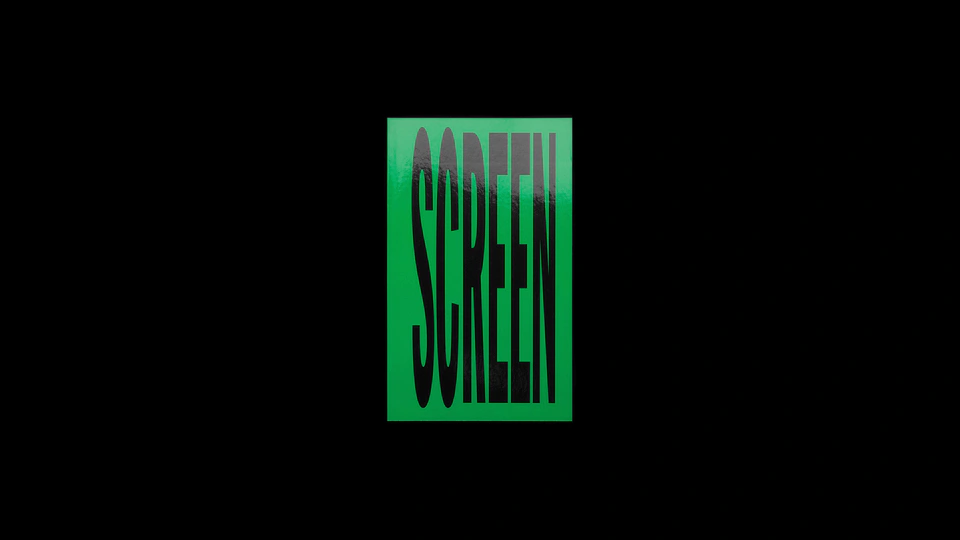

‘Inspired by Duchamp’s La Boîte verte (1934) and conceived as a dynamic and interface-driven book, it traces, retraces and contextualises a singular body of work: the active archive of an entire production since the age of one, solo or in groups, as an artist or curator.’
– Chronology
‘Images, words and references can be rearranged into changing connections, extending the archive into a form that can be handled and recomposed.’
– Chronology
external – Aby Warburg (1927–29) kept revising his groupings, so that the same image came back on other occasions. This site is a montage of the same kind: a work returns, and I ask what its new neighbours change, rather than give it a historical ancestor.
external – Hal Foster (2004) describes a constructive archive that proposes relations among displaced materials. Here the connection has to stay readable, and each piece keeps its own history.
Plate 8, recomposed. found – ‘…an associative system…’ (Chronology)
external – In Dream Mapping (1973), Susan Hiller brought individual dream maps together into shared arrangements. I place that operation beside this Atlas: a group of images keeps its separate origins while allowing a shared space to emerge.
Plate 7, box, shoebox museum. inferred – two boxes that make a collection portable, Duchamp’s, which inspired this site, and a home-made shoebox museum; scale and contents differ: ‘…Inspired by Duchamp’s La Boîte verte (1934)…’ (Chronology); “…home-made ‘shoebox museum’” (Lassnig, LUMA Arles)
inferred – Continue through History as organisation, Associative compositions, Making an archive live. These plates share this reading; each work keeps its own source and dates.
2 Naming and signatures
My name moves between sound, colour and code. AHFR splits Arthur Fouray into Art Hur Fou Ray and gives the syllables colour values. #aaafff carries A and F inside a web colour; rt4a compresses the name into a code. In Barcode Signature ID, a vectorised signature occupies the eyes of a display face. I return to the signature as a sign that can identify, circulate, conceal or become an image in its own right. As a signature, rt4a is a paradox: the mark of an artistic act, and an impersonal sign that hides the one who made it.




“Décomposition des quatre syllabes de mon prénom et de mon nom de famille.”
– M
‘RT4A attributes a work while saying less about its maker, so recognition need not depend on a recognisable style.’
– rt4a Index
external – For Donna Haraway (1988) all vision is partial, and knowledge answers for the place it is seen from. A signature tells you where a work comes from. It says little about the hands and institutions it passes through afterwards.
Plate 3, ART#AAA. found – ‘Art Hur Fou Ray m ART#AAA mm HUR FFF FOU#000 RAY FFF…’ (Art Hur Fou Ray)
Plate 6, cartels. found – ‘J’utilise cette forme pour mes cartels, ma carte de visite, et mon site web…’ (M)
inferred – Continue through Chromatic codes, Labels and classification, Typography and appropriation. These plates share this reading; each work keeps its own source and dates.
3 Chromatic codes
A colour can be a value, a name, a material or a background. #aaafff holds my initials while its paint varies with material and light; #000fff gives chroma-key blue the proportions of film formats. Baby works with light tones, and Void Drawing also uses colour codes. In my recent paintings, a coloured ground meets a drawn image. These different uses let colour organise what appears, and how it is read.
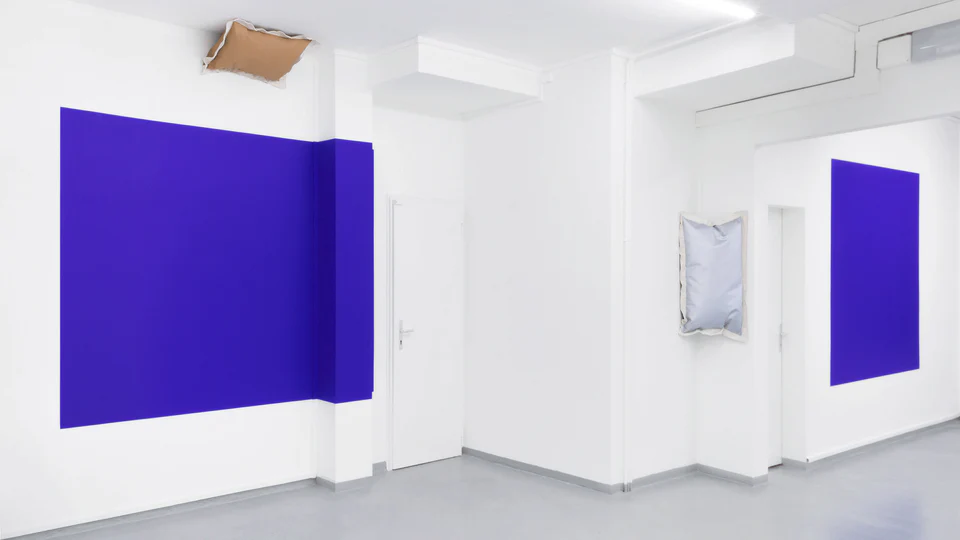
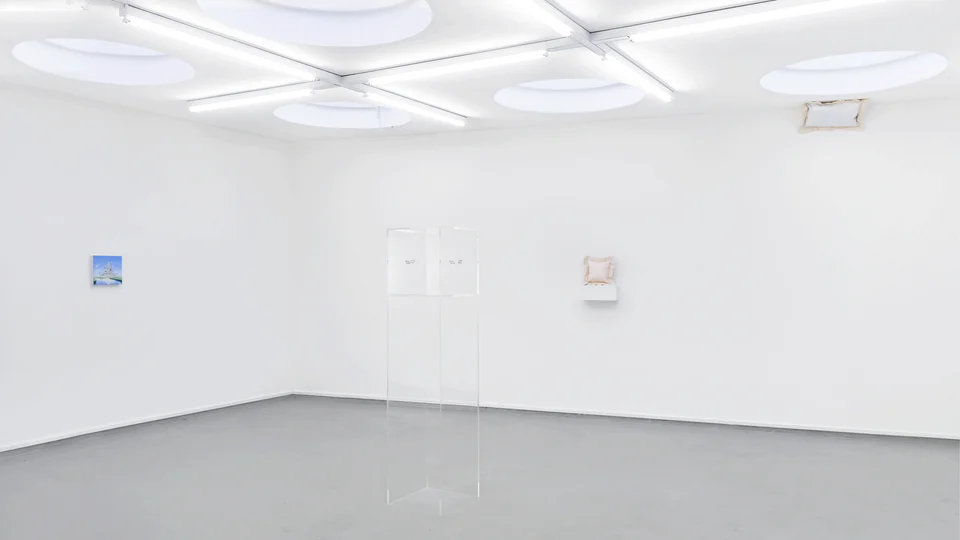

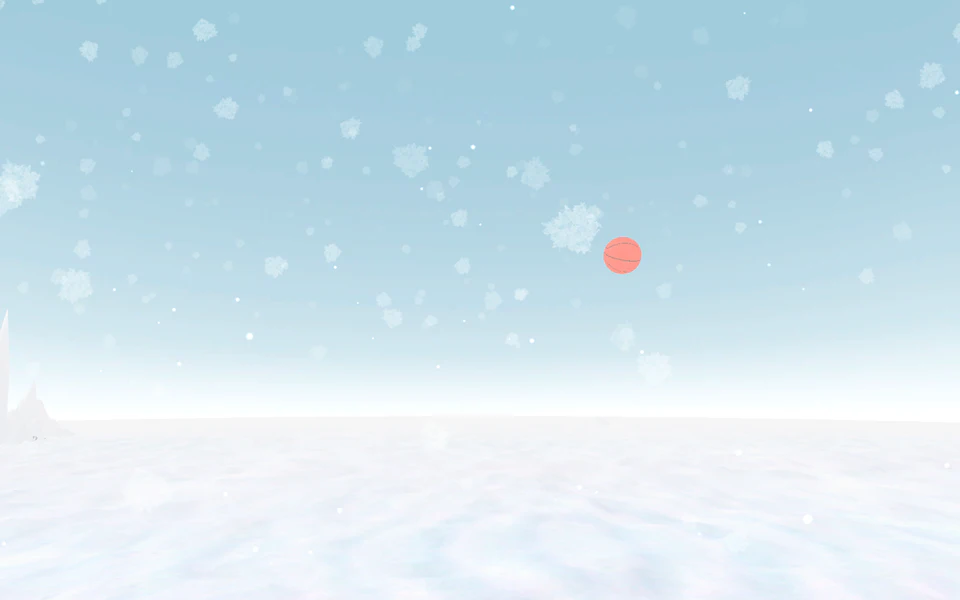
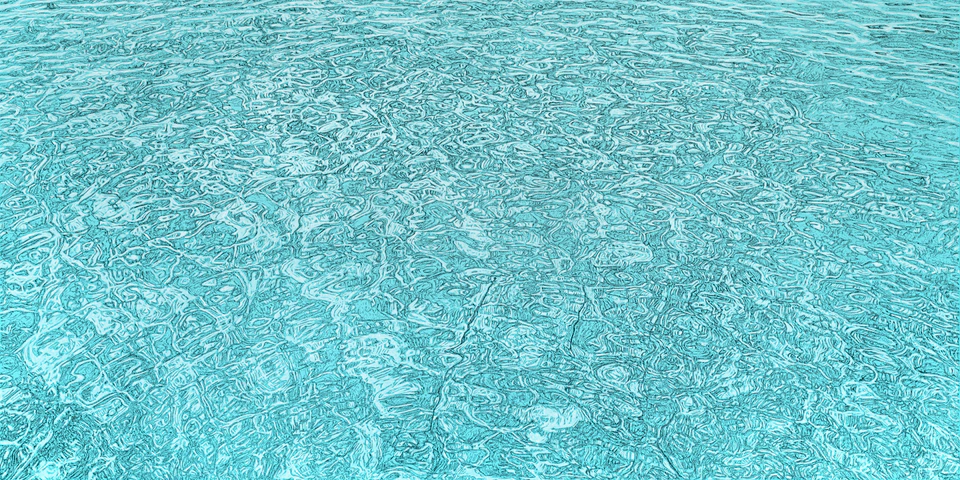
“I built wooden frames for the first #aaafff paintings; the paintings followed in 2014. The colour is mixed by eye from a screen, out of fluorescent pink, cobalt blue and titanium white, and painted on blackout fabric stretched over or wrapped round a found object.”
– Chronology
external – Nelson Goodman (1968) separates denotation from exemplification: a sample refers to some of the properties it actually has, as a swatch refers to its colour. The hex code names a colour; each painted surface is a sample of it, and never quite the same one.
Plate 5, #aaafff. found – ‘…its title names what is behind it…’ (#aaafff)
Plate 11, #000fff. found – ‘…begin the #000fff series…’ (Chronology)
inferred – Continue through Naming and signatures, Concealment and interfaces, Associative compositions. These plates share this reading; each work keeps its own source and dates.
4 History as organisation
Naming a period gives scattered works a place to gather. before ARTS and Pre-Natal organise earlier drawings, objects and experiments into bodies of work; Cartes-cartels returns the labels of 2012 to the present. A beginning is also an arrangement made afterwards. Dates, styles and ways of thinking provide different cuts through the same material. On arthurfouray.systems, I can go back to an early work from a recent one: the archive has several entrances, and a period need not close what it contains.
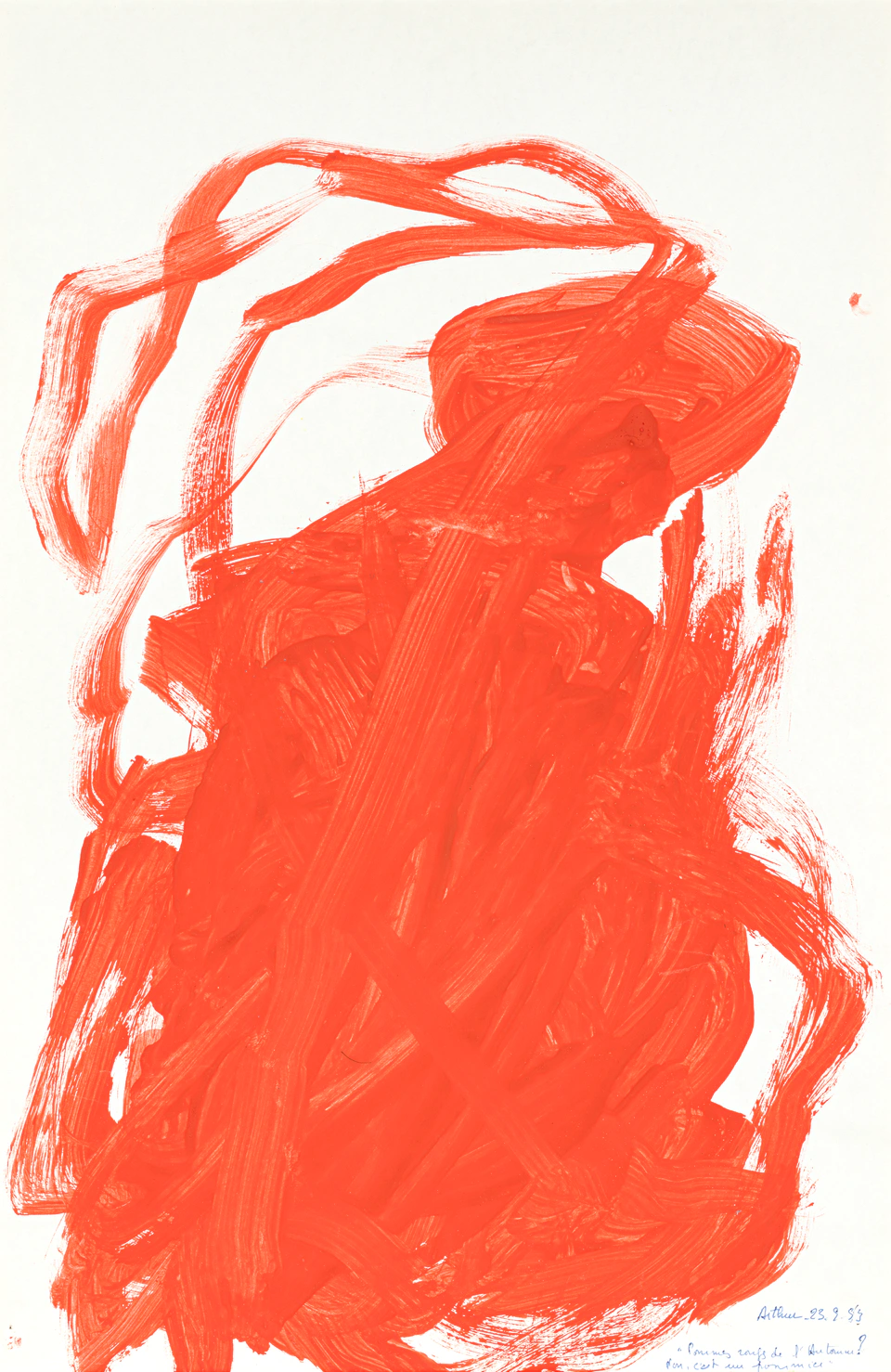
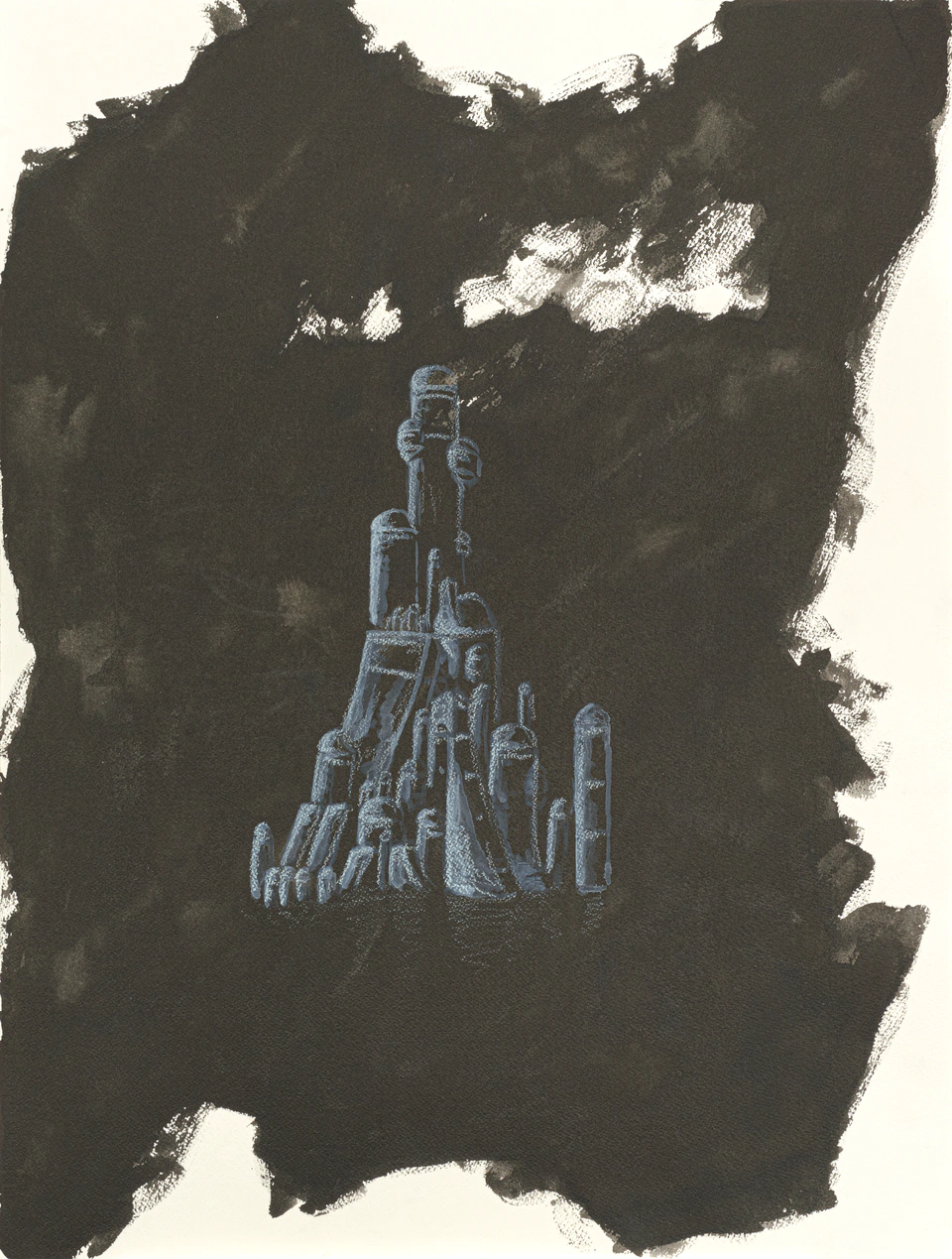


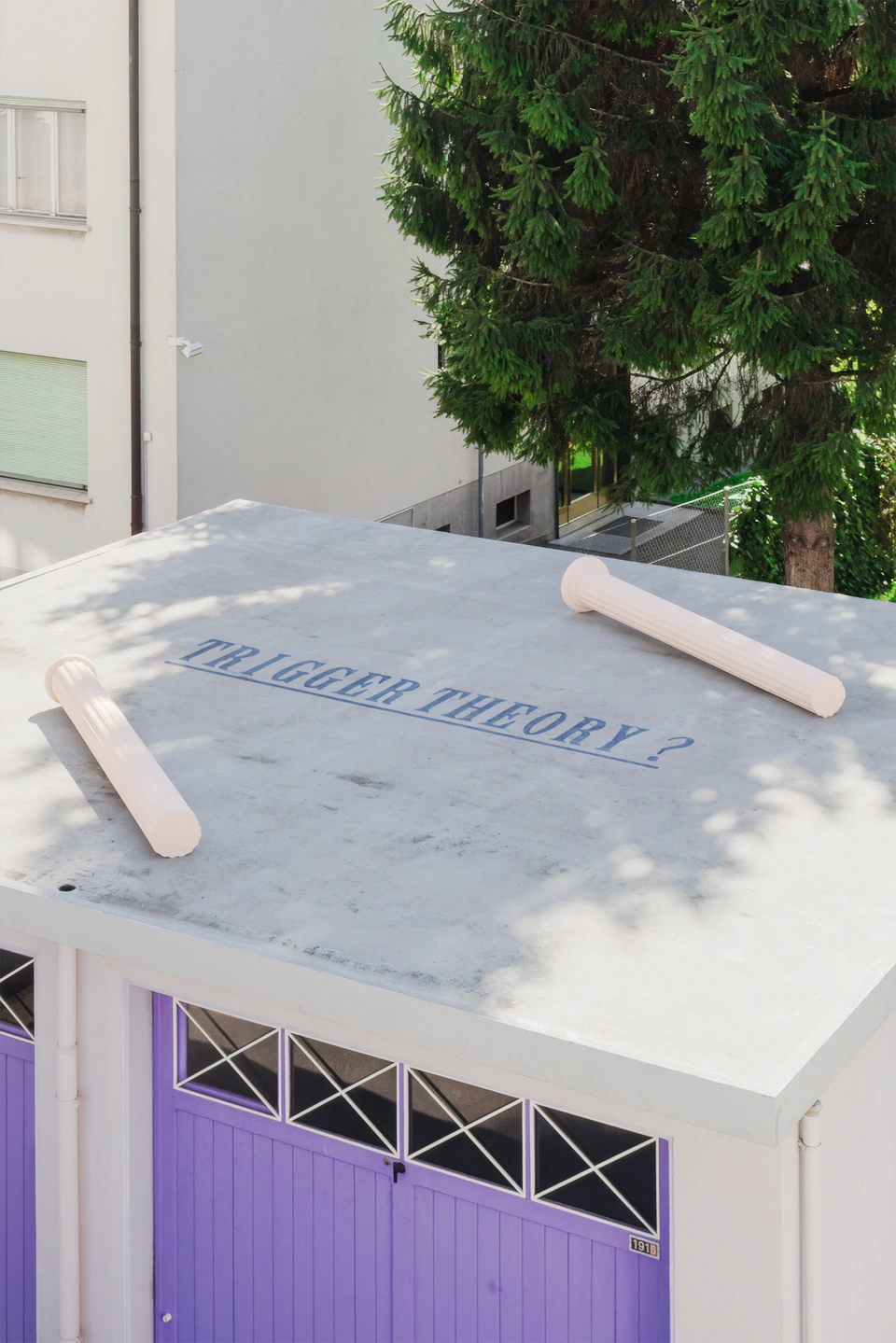

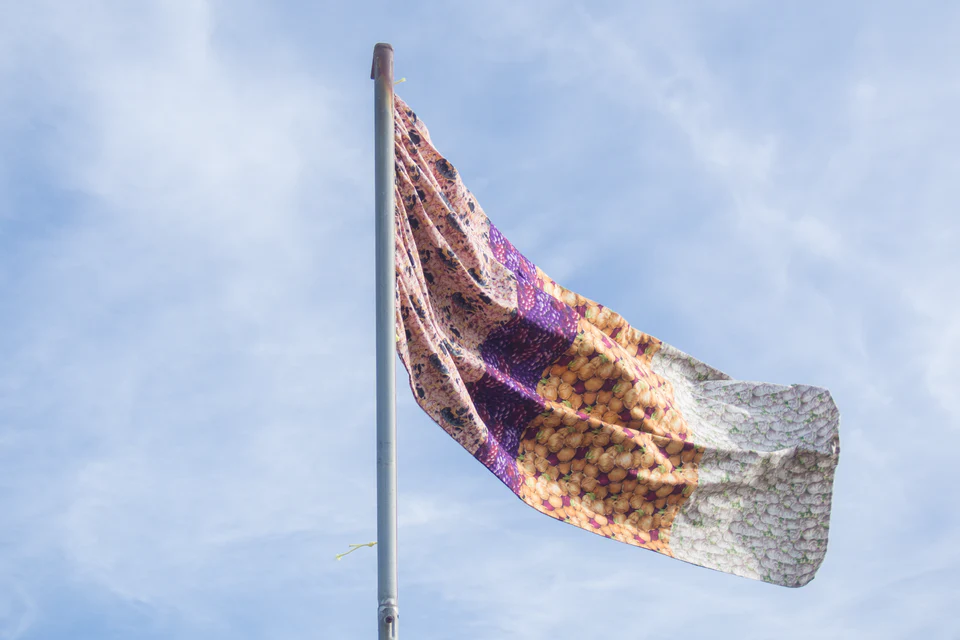
‘The catalogue gives materials and dimensions to an early body of sculpture, painting and installation and returns it to the present as an archival form.’
– Chronology
external – Drawings from 1993, comics from 2007, sculptures from 2010: I dated and described them years after making them. Jacques Derrida (1995) writes that the way an archive records also shapes what it keeps. The later labels make these early works available; they do not fill in what was never written down.
external – Hanne Darboven’s Cultural History 1880–1983 (1980–1983) combines images, documents and objects in an extensive arrangement. I read its organisation beside these periods: a chronology can gather personal and public histories while giving them a form to be entered again.
Plate 1, archival form. found – ‘…an archival form…’ (Chronology)
inferred – Continue through Archives and montage, Study and transmission, Working together. These plates share this reading; each work keeps its own source and dates.
5 Concealment and interfaces
The #aaafff paintings wrap objects whose names remain in the titles: an ashtray, a feather duster, a car. The Morel works and the book formats of my gouaches extend this question of an inside and an outside. A book can become an empty box; a surface can hold back what it suggests. I think of the interface as what connects two worlds. The screen stands between content and its receiver, as the painted covering stands between an object and the person looking at it.


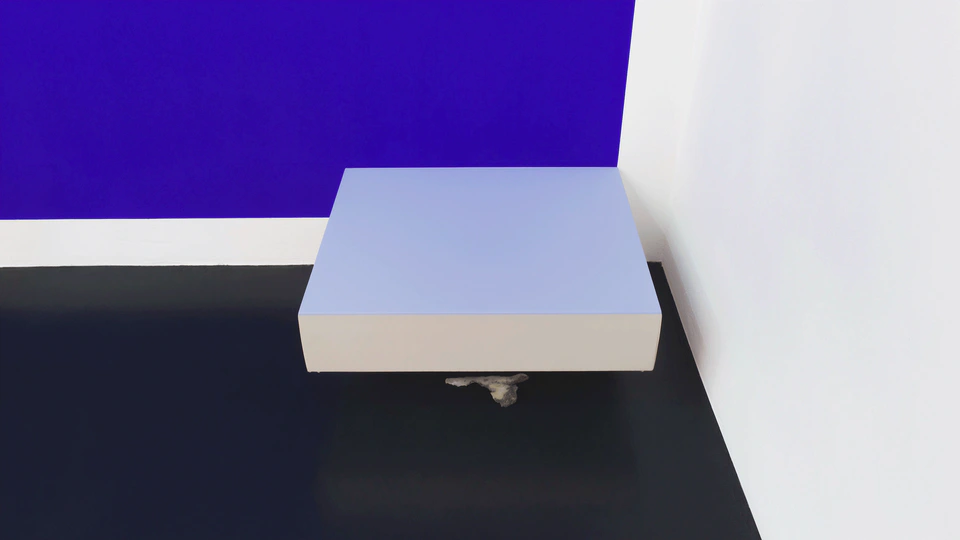


‘You face a monochrome, and its title names what is behind it.’
– #aaafff
‘On 24 October, during Caravan, I spoke at the Aargauer Kunsthaus with my former tutor Philippe Decrauzat and Katrin Weilenmann about the paintings as interfaces: a visible surface over an object concealed inside.’
– Chronology
external – Édouard Glissant (1990) claims a right to opacity: no one has to be made transparent in order to be in relation. His claim is about people and cultures. A hidden object is a much smaller case, and I keep it as a comparison.
external – The Warburg Institute restricts access to Warburg’s images of Pueblo ceremonies, at the request of the communities concerned. There the right to withhold an image belongs to living people; in my paintings it is only my decision.
Plate 9, monochrome. found – ‘Like the #aaafff, the canvas-objects are all monochrome…’ (Spectre)
inferred – Continue through Painting as an object, Projection and repetition, Display and museography. These plates share this reading; each work keeps its own source and dates.
6 Labels and classification
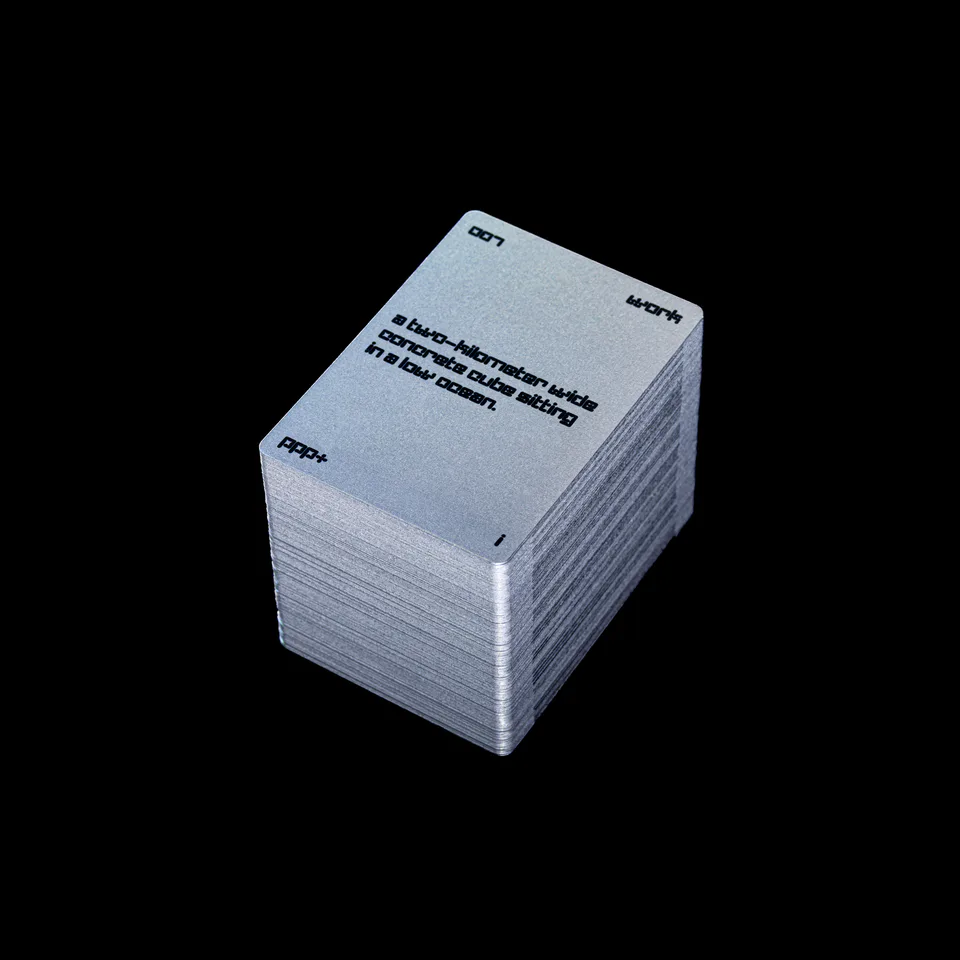
A label participates in a work: it gives a name, a date, a material, a place, sometimes a way to show it. In Playing Labels (Cartels à Jouer), the labels become cards that can be handled and played. P+ continues this interest in the information around an image. When I move a card, I move its classification and its possible relations too. A label can organise a collection, propose an exhibition or become the work’s form. Reading is already one of the actions the deck asks for.
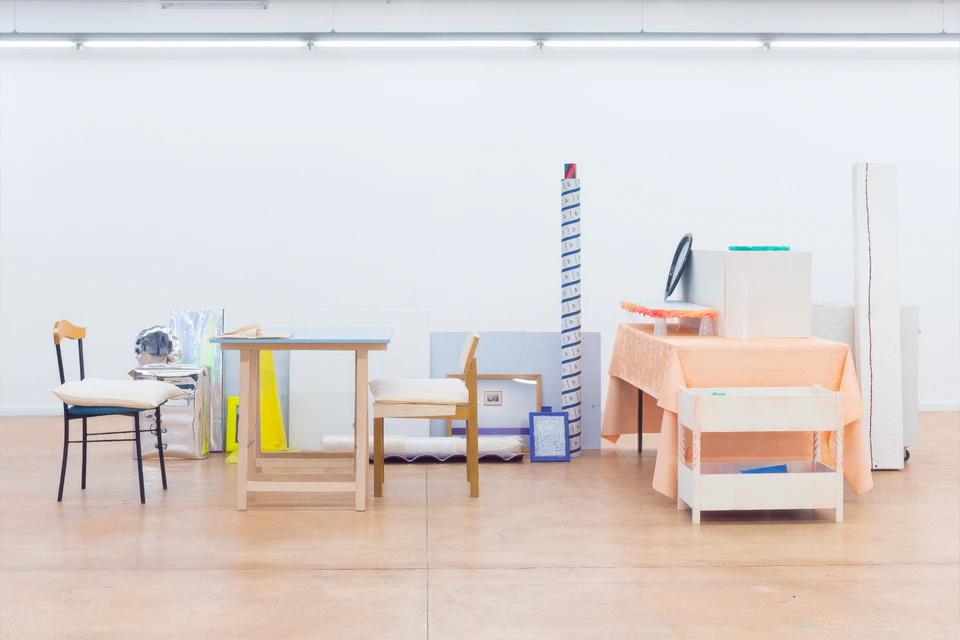
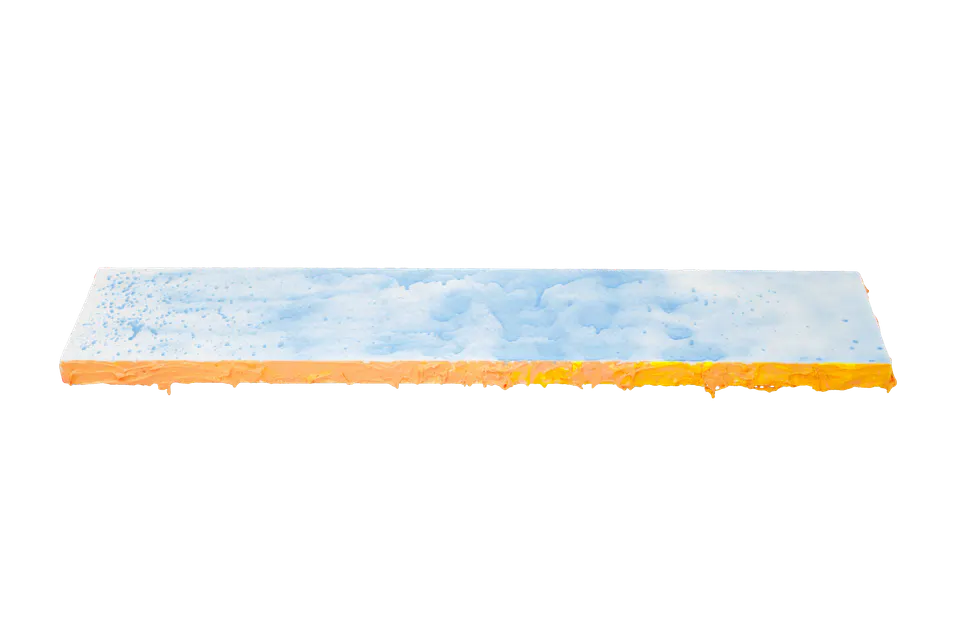


“Playing Labels (Cartels à Jouer), a deck of 37 cards whose title plays on cartes à jouer (playing cards) and cartels (wall labels).”
– Chronology
‘Labels and wall texts became part of the research.’
– Pre-Natal
external – Gérard Genette (1987) calls titles, prefaces and other thresholds paratexts, the edges that guide how a book is read. When the label is the thing on show, it no longer stands at the edge.
Plate 4, Cartes-cartels. found – “Cartes-cartels, forty pages of museum-style labels I made in 2023 for my works of 2012.” (Chronology)
inferred – Continue through Naming and signatures, Instructions and scores, Contracts and circulation. These plates share this reading; each work keeps its own source and dates.
7 The museum as a playground
The museum can be a playground for changing the conditions of an encounter. P+ I imagines a train arranged as a white cube and a museum in a refurbished cruise ship. For Caravan, red curtains covered the glass façade. The spaces of the museum become material: their thresholds, routes, supports and views can be rearranged. The Invention of Morel opens another possibility, a place in which an apparatus changes how reality is experienced. I set that fictional space beside these proposed and realised displays.
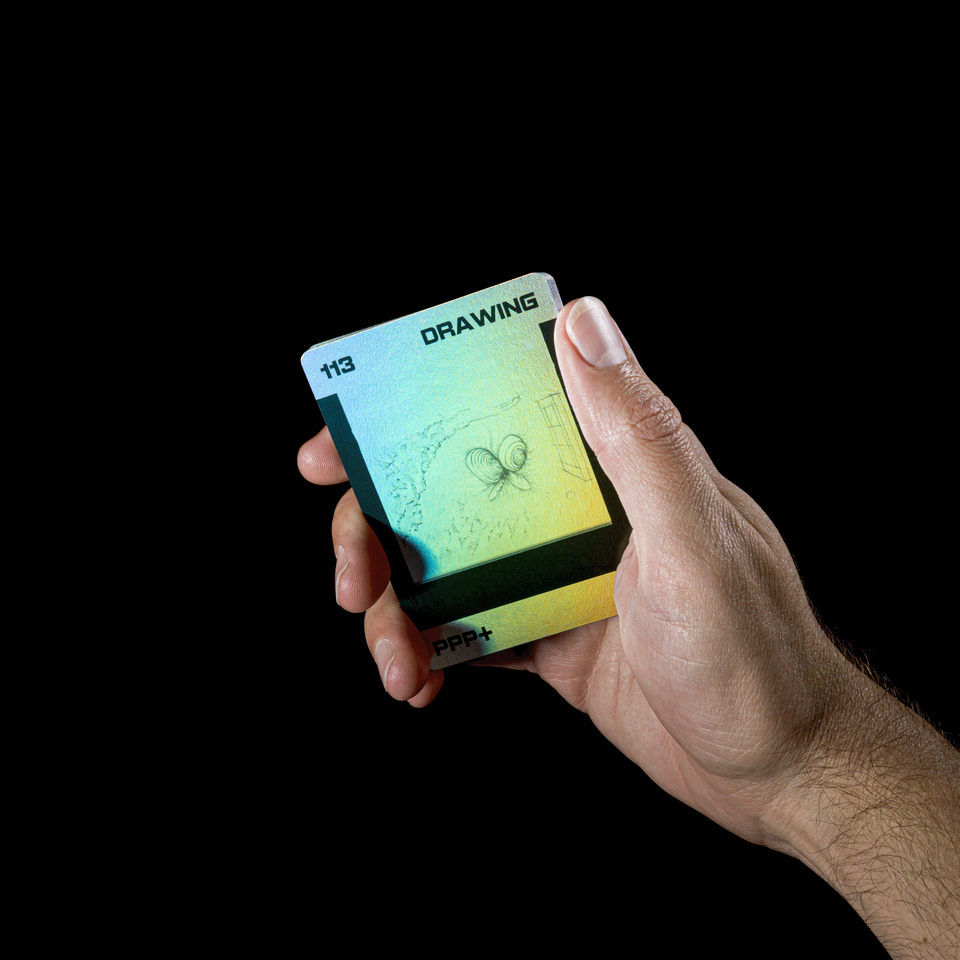
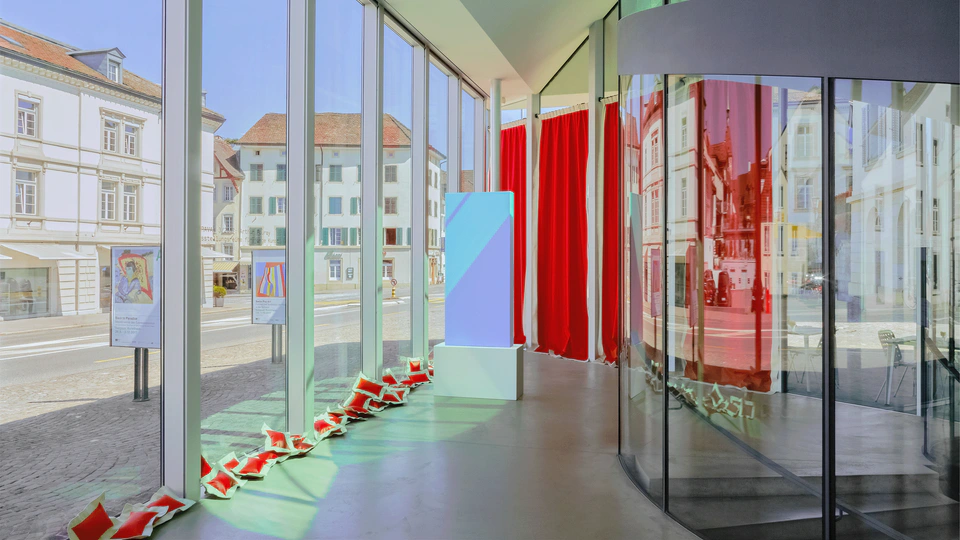
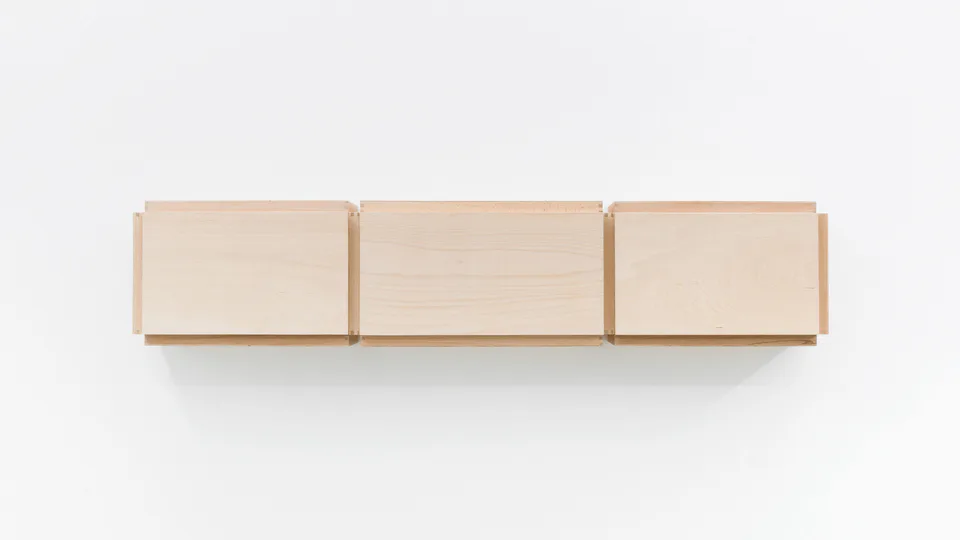
“Obrist discovered Lassnig’s work as a child, when he acquired a postcard of one of her paintings and tucked it into his home-made ‘shoebox museum’.”
– Lassnig, LUMA Arles
“A work of art when placed in a gallery loses its charge, and becomes a portable object or surface disengaged from the outside world.”
– Beware of Curator (music)
external – Robert Smithson, ‘Cultural Confinement’ (Artforum, 1972): the essay that AI voices read in my rt4a release Beware of Curator (2022).
external – Lygia Clark makes the encounter between a participant and an object part of what a work can be. Here the museum as playground concerns that active encounter: a space and a support offer someone a way to act.
Plate 13, night train. inferred – a museum train I proposed, and a documented journey by night train between encounters: ‘A train, arranged as a white cube…’ (P+ I); ‘…travelling by night train…’ (Glissant, LUMA Arles)
inferred – Continue through Projection and repetition, Display and museography, Instructions and scores. These plates share this reading; each work keeps its own source and dates.
8 Associative compositions
I work through associations: an image, a colour, a word or a title can bring another work into view. P+ makes this operation tangible, as cards that can form a project, a script or an exhibition. Free association in psychoanalysis offers a way to think about the paths between fragments, repetitions and displacements. In my recent paintings, a coloured ground and an image meet on one surface. Here the plate is an interface for that meeting; moving its elements changes what their association allows me to imagine.


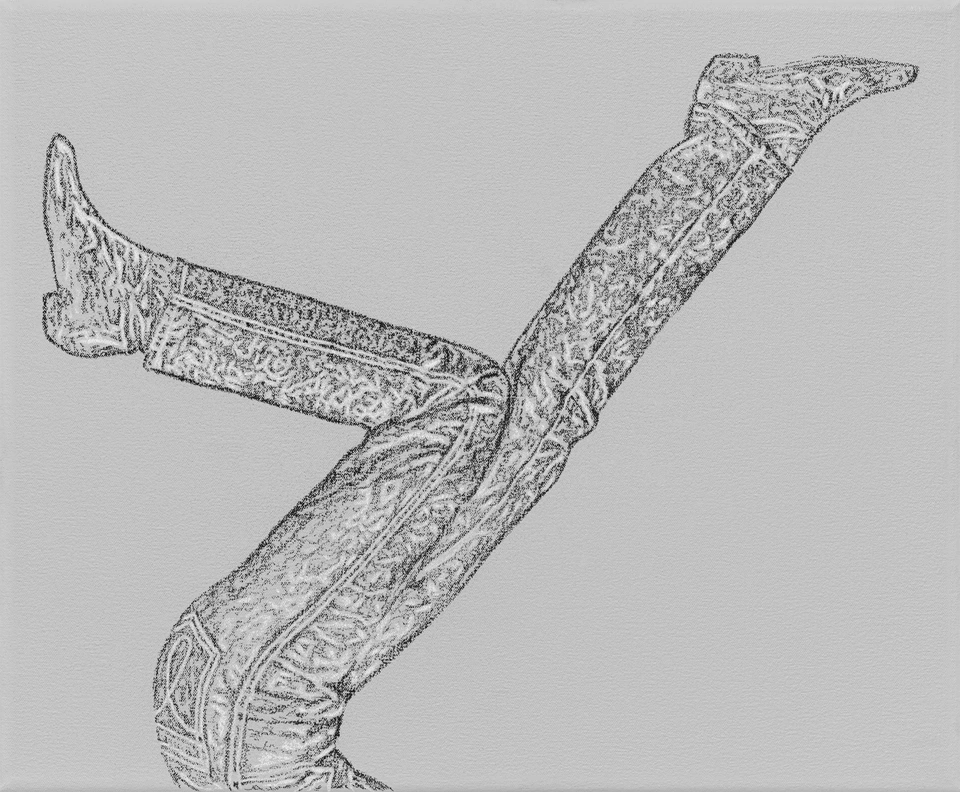
‘P+ is a game of associations, a corpus of possibilities in which prospects and projects can form storyboards, narratives, scripts, events and exhibitions.’
– P+
‘In two words: Oblique Strategies, the cards of Brian Eno and Peter Schmidt.’
– P+
‘I developed P+ as an associative system of physical and digital cards.’
– Chronology
external – Hal Foster (2004) makes connection a task, not a guarantee. Two cards side by side make a possible project; it becomes a documented relation only when another source supports it.
external – Brian Eno and Peter Schmidt (1975): their Oblique Strategies is the point of reference I gave P+.
external – Mary Kelly’s Post-Partum Document (1973–1979) brings objects, language and analytical arrangements together through feminism and psychoanalysis. I set its attention to signs beside the card: a fragment can carry several relations, and the arrangement makes those relations available for interpretation.
Plate 13, utopia. inferred – the P+ prospects can end in a utopia or a dystopia; the Glissant book I co-edited answers in its title that utopia is necessary: ‘…a utopia or a dystopia.’ (P+); Édouard Glissant, Dans un monde imprévisible, l’utopie est nécessaire (Biography)
inferred – Continue through Archives and montage, Chromatic codes, Science fiction as an interface. These plates share this reading; each work keeps its own source and dates.
9 Painting as an object
A bed base or a pillow is already an object with a use, a scale and a place in everyday life. The Lauren and Kasimir paintings take those things as their supports, bringing painting into the room and the relations between its objects. Covering a support leaves its shape active; an image or colour is embedded in a thing rather than detached from it. Concealment, display and the interface return here as physical questions about how a painting occupies reality.


“The series began in 2013, when Arthur Fouray decided to stretch a canvas over the base of his bed.”
– Spectre
“Andy and Kasimir are the protagonists of the ‘canvas-objects’ series.”
– Spectre
external – John Roberts (2010) places artistic technique inside the social division of labour. A bed base saves me the stretcher; it does not save me the painting.
inferred – Continue through Chromatic codes, Concealment and interfaces, Language and objects. These plates share this reading; each work keeps its own source and dates.
10 Tags and circulation
A tag gives an image a route through other images. In Pierre Joseph’s exhibition at DOC! in 2018, searches for #potato connected photographs to a shared word, while starch connected film and the glue on the wall. I read this as a way of working inside a code and redirecting it. Tags and hashtags classify, circulate and recombine what they name. That operation also runs through my colour codes, signatures, titles and labels: a familiar sign can be used again, and its new setting changes what it does.


“One only needs to search for the hashtags ‘#potato’, ‘#potatoes’ (and all their variants, including in Esperanto)”
– Pierre Joseph, Fondation Vincent van Gogh Arles
“From the starch that fixes the image on film to the starch glue binding the forty-five ‘endless photographs’ to the DOC wall.”
– Pierre Joseph, Fondation Vincent van Gogh Arles
“Also a pleased victim of ‘Aura’s migration’”
– Pierre Joseph, Fondation Vincent van Gogh Arles
external – Hito Steyerl (2009) defends the poor image, a copy worn by compression and valued for how far it travels. At DOC! the hashtag is one way of sorting the images; the starch and the wall are other material stages of their circulation.
external – The same potatoes exist as search results and as forty-five ‘endless photographs’ on the DOC! wall. Claire Bishop (2024) describes an attention split between the work in the room and its documentation on a screen. A search and a visit give two kinds of access to the same images, and neither replaces the other.
Plate 6, keywords and labels. found – ‘He parasitises keywords and labels…’ (Pierre Joseph, Fondation Vincent van Gogh Arles)
Plate 11, green screen. inferred – a green screen and a chroma-key blue surface are both colours keyed for an image; whether the two works share a technique remains a question: ‘…the perfect green screen…’ (Pierre Joseph, Fondation Vincent van Gogh Arles); ‘…three chroma-key blue wall paintings…’ (Chronology)
inferred – Continue through Images across media, Typography and appropriation, Communication and distance. These plates share this reading; each work keeps its own source and dates.
11 Projection and repetition
Polyvision is Abel Gance’s three-screen process for Napoléon (1927), and #000fff (polyvision) takes its name from it. The Morel works refer to Adolfo Bioy Casares’s The Invention of Morel, in which recorded actions return as a repeated reality. A projection makes something present on a surface while its apparatus can remain elsewhere. I connect it to the concealed object and the interface: an image reaches us through a support, a frame and a device that shapes the encounter.


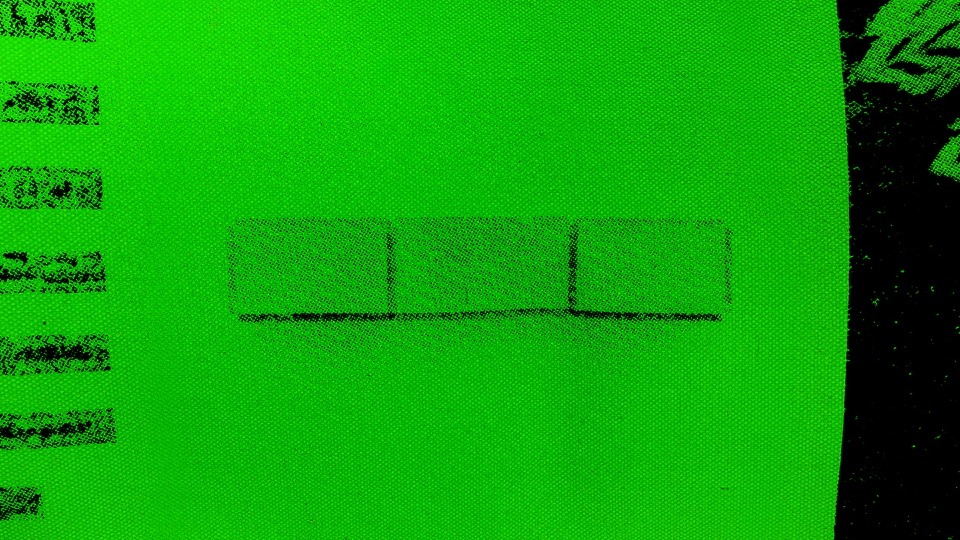
“#000fff polyvision is a mural painting at the maximum saturation of the colour #aaafff. The work no longer hides an object but suggests its projection.”
– Spectre
‘The painting I made for it, #000fff (Polyvision) (Spectre), takes its name from Abel Gance’s three-screen process for Napoléon (1927)’
– Chronology
‘In Adolfo Bioy Casares’s novel, Morel invents a machine that records the actions of human beings and loops them, reproducing reality.’
– SCREEN
external – The #000fff paintings are blue screens waiting for a projection, and Morel takes its name from a machine that records people and plays them back for ever. Harun Farocki’s Eye/Machine (2000) shows images that machines make for other machines, to guide an operation. Morel’s recording does nothing of the kind: it keeps an appearance going, and that is all it does.
external – Giorgio Agamben (2000) defines gesture as the display of a means as such, an action shown with no end beyond itself. Repeated, a gesture becomes available again, and the repetition also shows how far it now is from the moment it was made.
Plate 7, The Invention of Morel. inferred – compare two uses of Morel’s fictional recording; no direct relation between works is stated: ‘The Invention of Morel is one of the key concepts behind the relational aesthetics movement.’ (SCREEN); ‘An island, replicating the epiphany from The Invention of Morel…’ (P+ I)
Plate 14, curtain. found – ‘…with the curtain as the projection surface.’ (SCREEN)
inferred – Continue through Concealment and interfaces, The museum as a playground, Science fiction as an interface. These plates share this reading; each work keeps its own source and dates.
12 Fiction, myth and transformation
Monsters gathers mythological creatures; We Are the Extraterrestrials asks about ordinary life in space. Fiction, tales and the unknown give familiar things another setting. A creature, a planet or an invented machine can become a tool for looking at the known: a body, a home, a social order, a way of communicating. The questions in the songs stay small and practical. I set them beside Morel’s repeated world and the futures of Foundation, as different ways an imaginary situation can return us to the present.



‘For six minutes and twenty seconds the lyric names more than four hundred monsters from myth, folklore and fiction, from Tizheruk to Taniwha.’
– Monsters (music)
“Each verse asks ‘Isn’t it nice to…’: to live in a spaceship, to eat some stones, to take a bath on Neptune, to wear the rings of Uranus.”
– We Are the Extraterrestrials (music)
external – Aby Warburg’s Pathosformel is a formula of gesture and emotion that survives from antiquity into later images. A list of names can start that kind of comparison; on its own it shows no survival.
external – Ursula K. Le Guin’s The Carrier Bag Theory of Fiction (1986) treats the story as a container for what people gather and carry. I read this beside the Atlas and the cards, where encounters, objects and unfinished processes can coexist.
Plate 7, spaceship. inferred – a song asks whether it would be nice to live in a spaceship; P+ would put a museum on a cruise ship: ‘Isn’t it nice to live in a spaceship?’ (We Are the Extraterrestrials (music)); ‘…a refurbished cruise ship.’ (P+ I)
inferred – Continue through Projection and repetition, Science fiction as an interface, Language and objects. These plates share this reading; each work keeps its own source and dates.
13 Making an archive live
An exhibition gives an archive a place, a sequence and a present audience. With Hans Ulrich Obrist I co-organised at LUMA Arles exhibitions drawn from his archives, including Édouard Glissant, Etel Adnan and Agnès Varda. Documents, images, works and conversations enter new relations when they are displayed together. The archive becomes something people can move through and reactivate. My exhibitions at DOC! and Silicon Malley also worked with encounters between artists and materials. I think of exhibition making as a way to let an archive live: each presentation opens another route through what it holds.

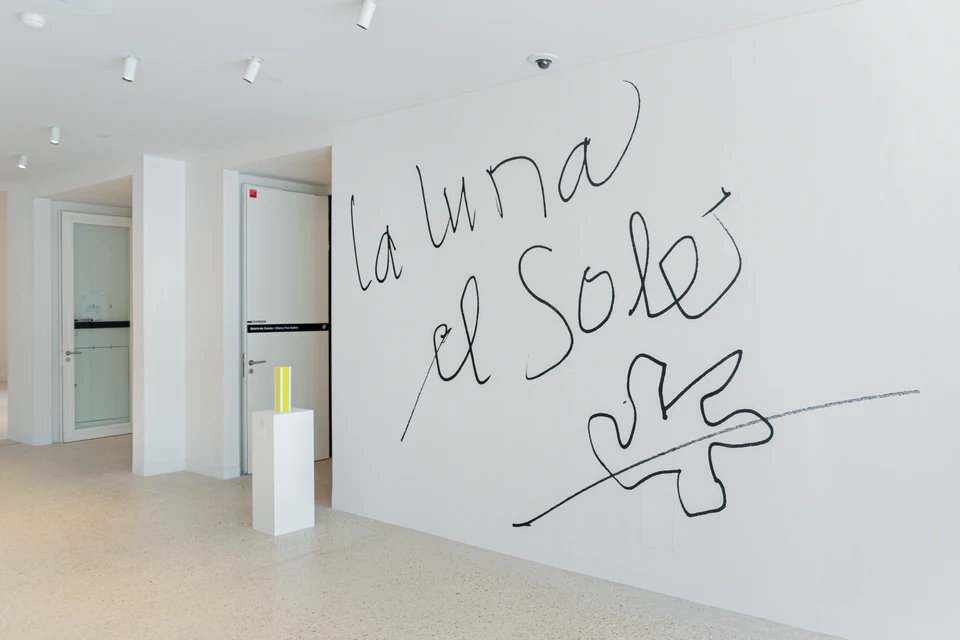
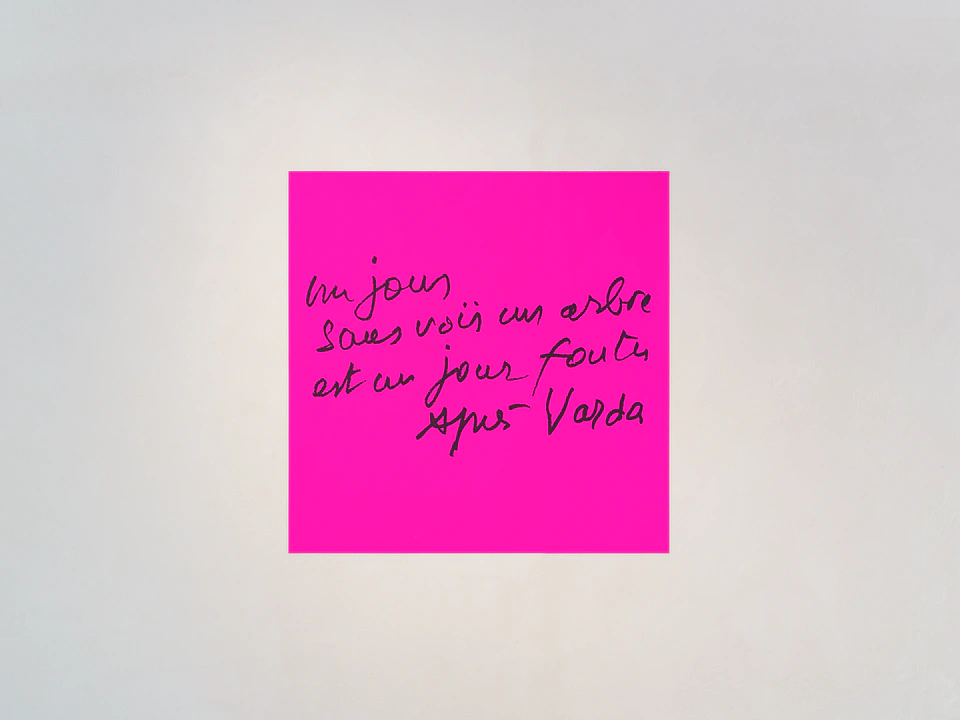


“In 1986, Obrist visited the studio of Peter Fischli & David Weiss in Zurich, on the eve of the production of their film Der Lauf der Dinge [The Way Things Go, 1987], featuring a series of chain reactions involving ordinary objects set in motion where one thing leads to another.”
– Glissant, LUMA Arles
“From this meeting onwards, he began visiting artists’ studios, travelling by night train, each encounter leading to another, each artist sending him to others.”
– Glissant, LUMA Arles
external – In Hal Foster (2004), archival artists propose connections and leave them provisional. An exhibition makes one path through the documents; it does not stand in for the archive.
external – Claire Bishop (2024) treats research-based art as a negotiation of abundant information. Sampling and sustained reading give different access to a collection; its extent cannot be equated with what one visitor absorbs.
inferred – Continue through Archives and montage, Display and museography, Working together. These plates share this reading; each work keeps its own source and dates.
14 Display and museography
How a painting is hung changes the space between the work and its viewer. SCREEN begins with the question of hanging before picture rails. On Italian Museography returns to display through BBPR’s Castello Sforzesco in Milan. I set this beside Carlo Scarpa’s Castelvecchio in Verona: another museum where the arrangement and supports of works matter. A mount, an interval, a route or a frame can act as an interface. Museography gives form to the encounter, and that form is part of what I study.
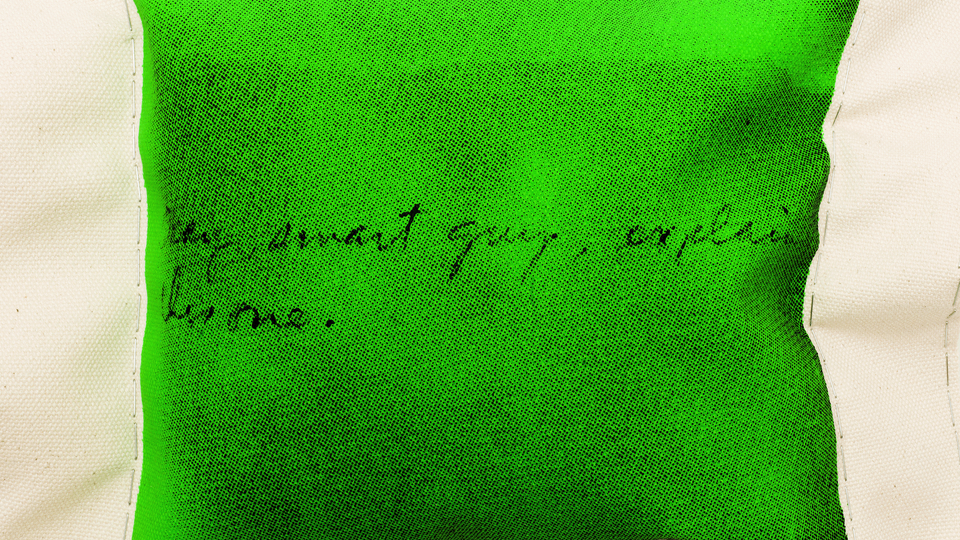
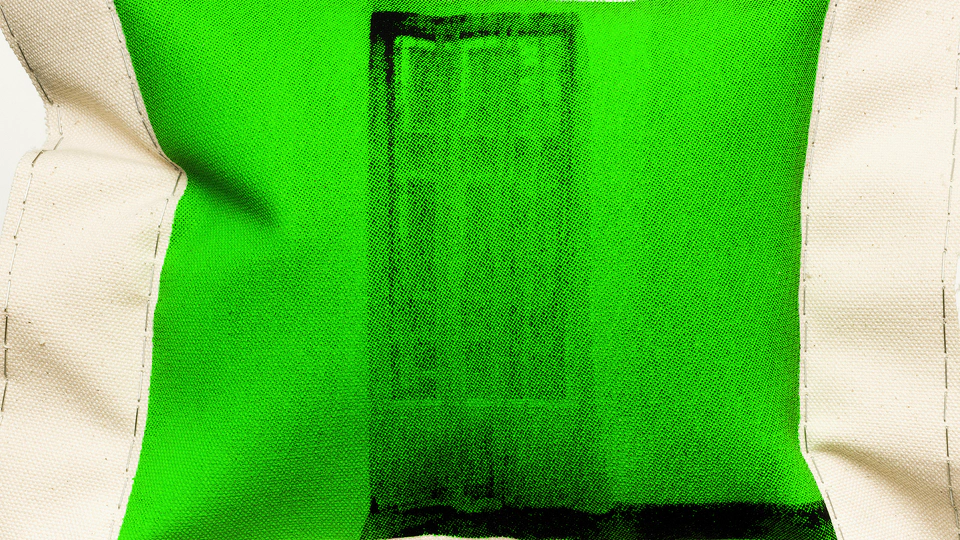


‘For six months I wanted to discover a new arrangement: how were paintings hung, historically, before picture rails?’
– SCREEN
‘That question remains unanswered.’
– SCREEN
external – Jacques Rancière (2000) calls the distribution of the sensible the order that decides who can see and who can speak. Moving a painting off the rail changes what a visitor sees. It does not, by itself, change who gets to look.
inferred – Continue through Concealment and interfaces, The museum as a playground, Making an archive live. These plates share this reading; each work keeps its own source and dates.
15 Science fiction as an interface
The pink of these information pages refers to Philip K. Dick’s late VALIS trilogy: VALIS, The Divine Invasion and The Transmigration of Timothy Archer. In VALIS, information arrives through pink light. Science fiction gives me an interface for interpreting the real: another system of knowledge can make the familiar strange. Foundation places Asimov’s fiction beside contemporary art foundations. I read these possible worlds as ways to ask how a present is organised, what it preserves and which futures it can make imaginable.
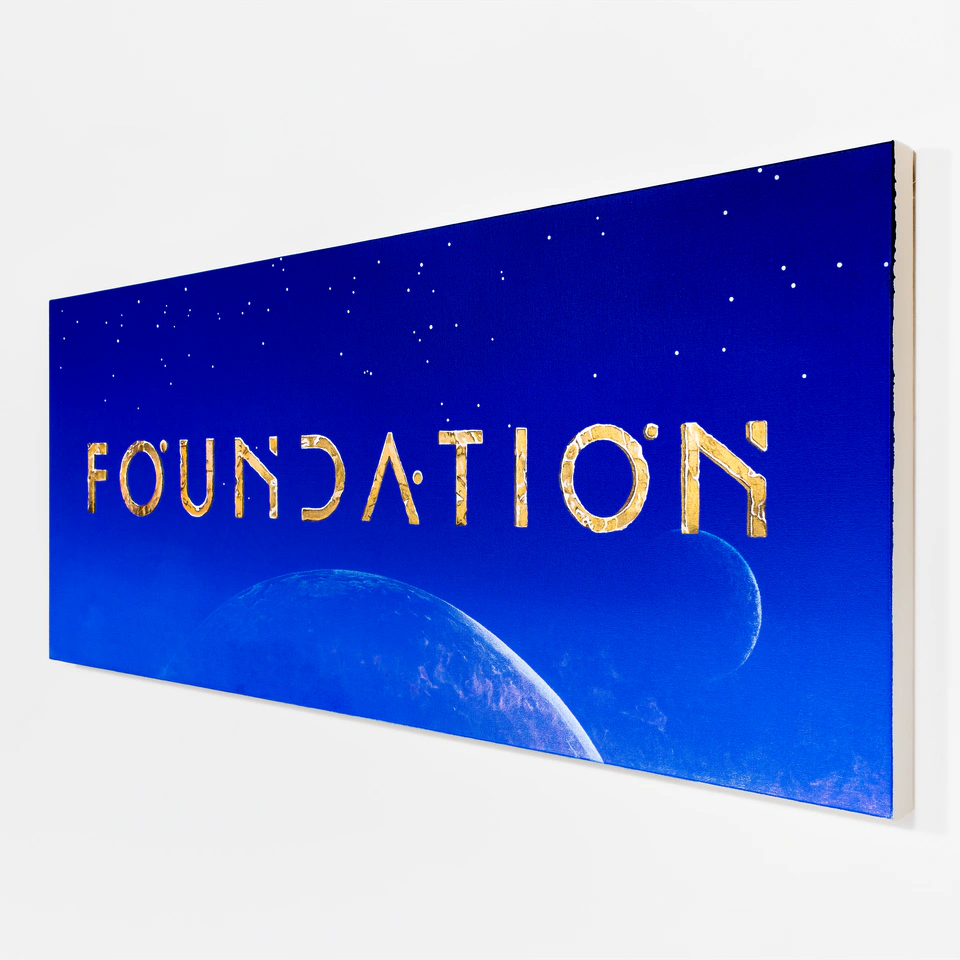
‘Ecology, inclusion, technology: are these shared pursuits not strategies to preserve the Earth’s species, as psychohistory is a tool of preservation in Asimov’s saga? Do they not lay the ground for life on another planet, like Asimov’s plan to move a scientific elite to a remote planet to save a galaxy from barbarism (a questionable goal)?’
– Foundation
external – For Donna Haraway (1988) knowledge is always situated: someone holds it, from somewhere, and answers for it. An archive for the future depends on who keeps it and who may open it, as much as on what it stores.
Plate 7, ship. inferred – two ways of taking culture away from where it was made: a museum aboard a cruise ship, and an elite sent to a remote planet: ‘…a refurbished cruise ship.’ (P+ I); ‘…a remote planet…’ (Foundation)
external – Ursula K. Le Guin’s carrier bag offers a shape for a possible world made through collecting, holding and sharing. It opens this plate’s futures beyond one prediction or central figure, and returns science fiction to the things and relations of everyday life.
Plate 12, planets. inferred – a remote planet as the place where knowledge is kept safe, and a planet you could take a bath on: ‘…a remote planet…’ (Foundation); ‘Isn’t it nice to take a bath on Neptune?’ (We Are the Extraterrestrials (music))
inferred – Continue through Chromatic codes, Associative compositions, Fiction, myth and transformation. These plates share this reading; each work keeps its own source and dates.
16 Images across media
An image moves between painting, record sleeve, thumbnail and screen. Four paintings return on rt4a releases: Beware of Curator, Accelerate, This Is Not a Tender World and Chiquito. A new title, scale or medium changes how the same image addresses its receiver. A sign can become a symbol, an illustration can become a cover, and a cover can send someone back to a work. In the Beware of Curator release, voices read Smithson’s ‘Cultural Confinement’. Image, language and sound carry material across the boundaries of a single work.


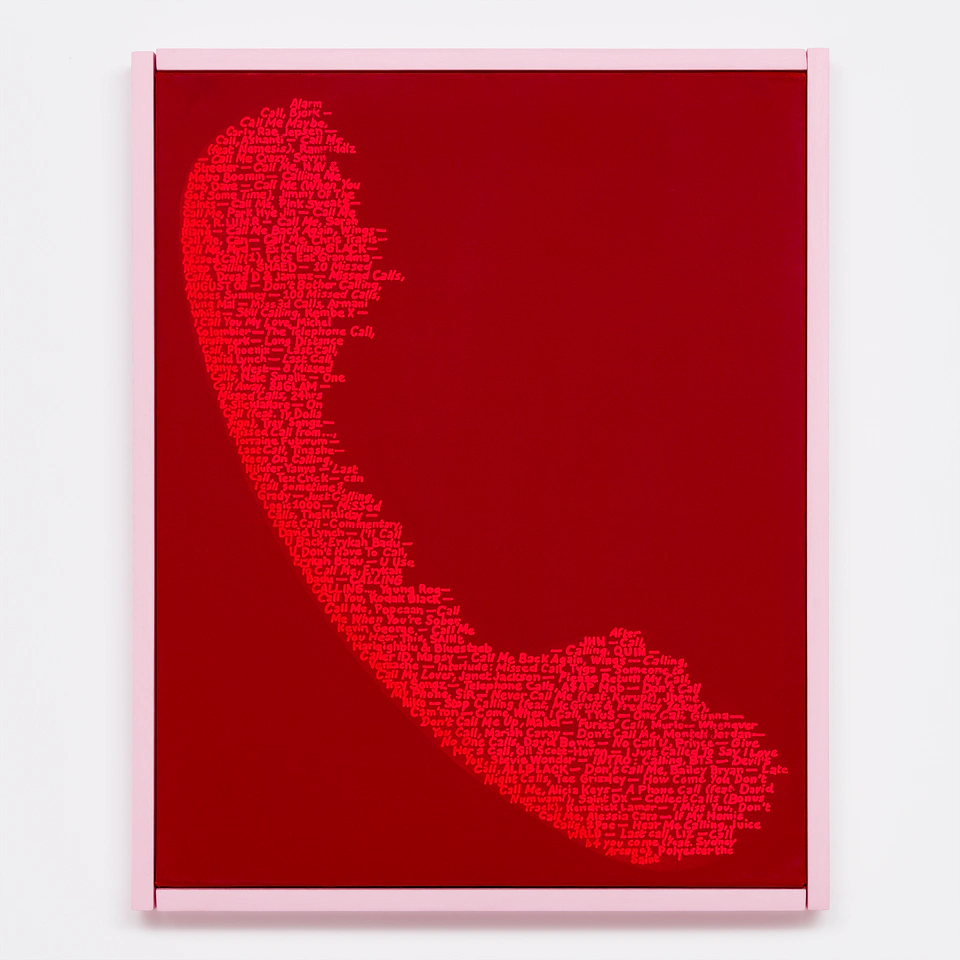
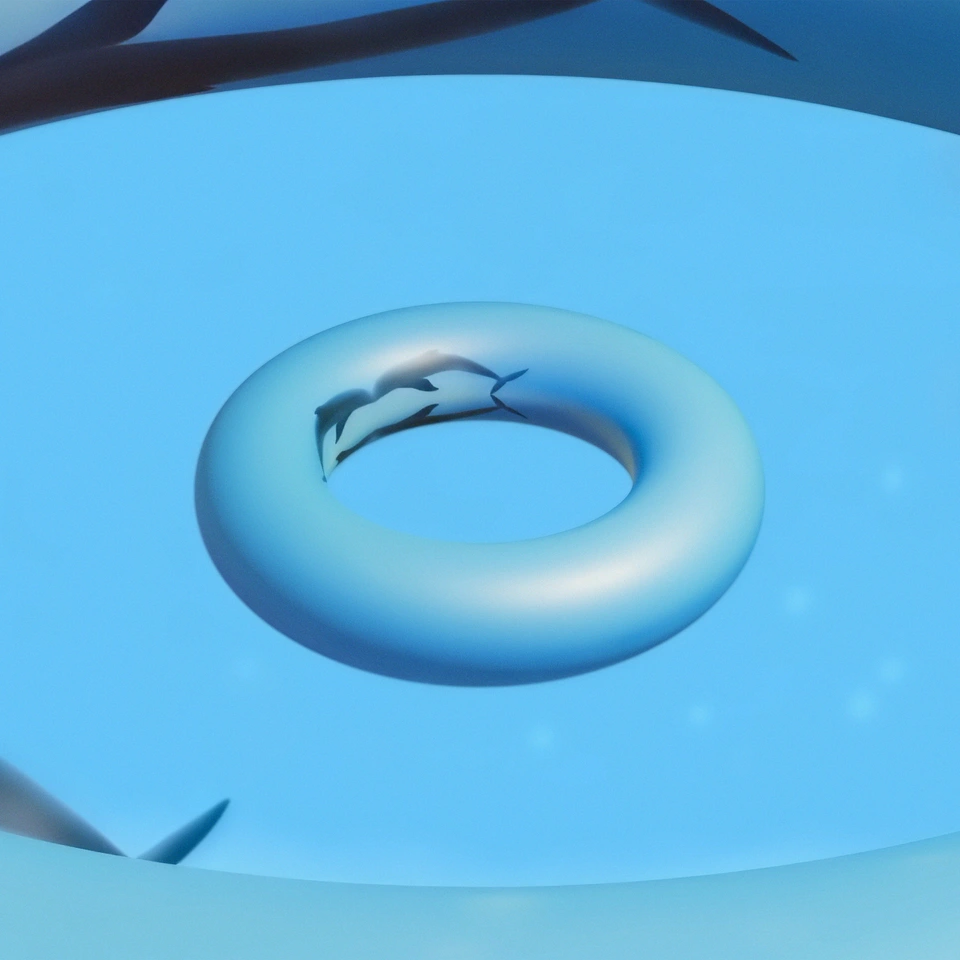
“The song takes elements from the theme of The Matrix and sets them over beats inspired by Massive Attack’s ‘Teardrop’ (1998).”
– Chiquito
external – For Hito Steyerl (2009) distribution is part of what an image is. A painting that becomes a cover reaches other people through other channels; the painting and the song remain two works.
Plate 19, a + o –. inferred – a + o –, the practice I shared with NCM from 2013 to 2015, is carried in the bracket of a song title: ‘Ecco Beach (a + o –) rt4a…’ (Ecco Beach (a + o –) (music))
inferred – Continue through Naming and signatures, Tags and circulation, Communication and distance. These plates share this reading; each work keeps its own source and dates.
17 Typography and appropriation
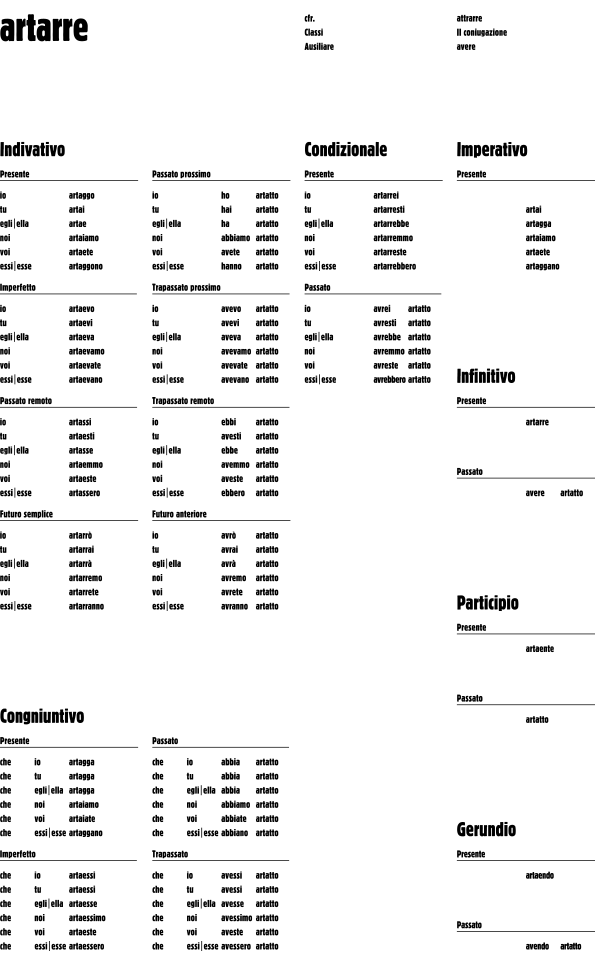
A borrowed typeface or logo brings a recognisable form into another use. Museum uses Marvel; IDEA works with IKEA; Beware of Curator redirects a warning sign. Artarre borrows Art Basel’s Block typeface, M works through several typefaces, and SCREEN stretches Franklin Gothic. This continues across arthurfouray.systems: letters and signs give different bodies of work different forms. Typography carries an organisation’s voice, a memory or an instruction. Changing its wording or proportions lets that familiar form say something else.


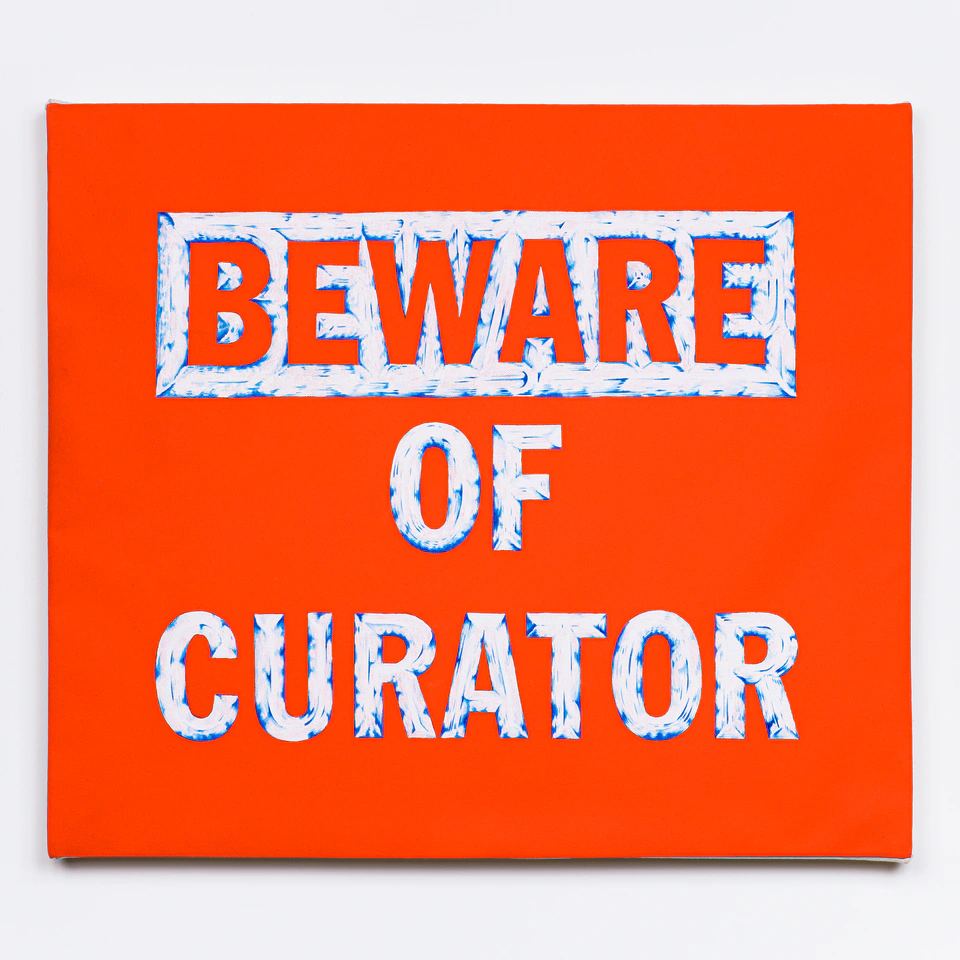
“Museum (Fraser Official Welcome) puts the word ‘Museum’ in the Marvel logo; Beware of Curator takes the form of a warning sign.”
– Chronology
external – Andrea Fraser (2005) places the institution in the practices through which art is recognised and valued. When I borrow a voice, it can expose those practices, but the work cannot step outside them.
Plate 16, Beware of Curator. found – ‘Beware of Curator is also paired with a sound work released in 2022, the single Beware of Curator – Smithson Cultural Confinement.’ (Chronology)
inferred – Continue through Naming and signatures, Labels and classification, Language and objects. These plates share this reading; each work keeps its own source and dates.
18 Communication and distance
CALL gathers songs around a word for telecommunication and the forms of love in their titles. A call joins people across a distance; it also makes that distance felt. Gustav Metzger’s telephone boxes, Matthieu Laurette’s phone expenses and Pierre Joseph’s circulating tagged images offer other routes through communication. A device, a bill or a hashtag can organise who reaches whom and what travels between them. I place these beside signatures and sleeves: the message has a material form, and its route can become part of the work.
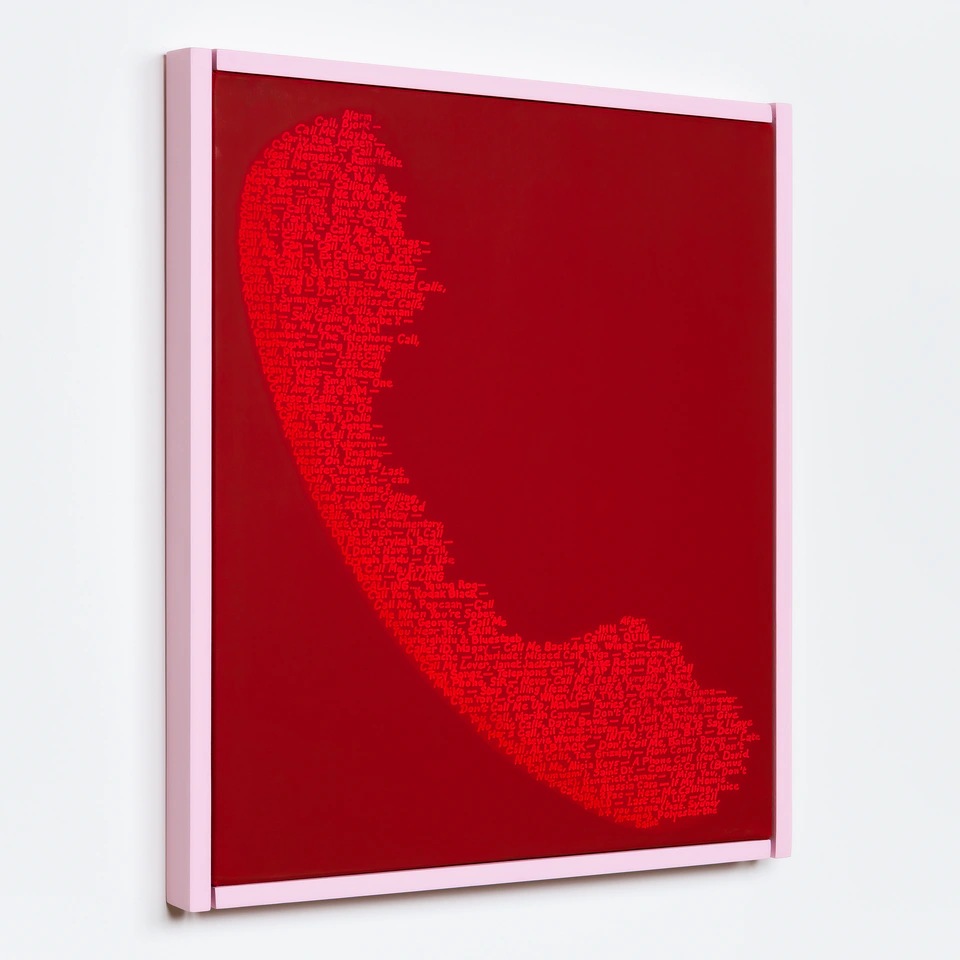
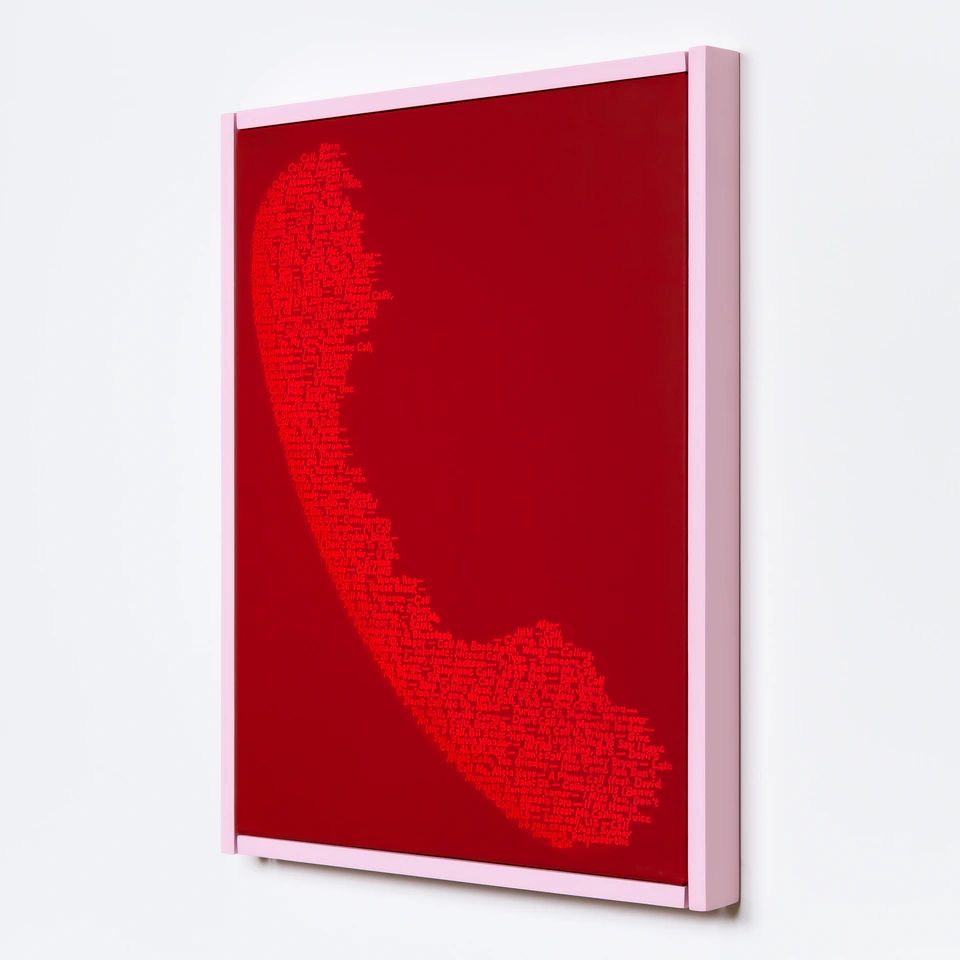

‘A word for telecommunication becomes, in these songs and their titles, the many forms of love.’
– CALL
“Cultivating mystery, Metzger used red telephone boxes as his means of communication.”
– Metzger, LUMA Arles
external – Aby Warburg (1929) named Denkraum the space for thought a person keeps between themselves and the world. Next to CALL, it makes me ask whether a call keeps that distance or closes it. The comparison is mine; the shared word is not evidence of influence.
Plate 16, CALL. found – ‘Call began with a personal Apple Music playlist.’ (CALL)
inferred – Continue through Tags and circulation, Images across media, Contracts and circulation. These plates share this reading; each work keeps its own source and dates.
19 Language and objects
Words can be carved into clay, covered by glaze, named in a title or translated into an object. Feast and Hope were made in Granada and fired again in Arles; their lettering passes through that material change. In Welcome to the Art World, I draw a ceramic by Alfredo Aceto that I never received. Language can give an absent thing a place, as a title or a picture can propose possession. The objects of a + o – bring the vocabulary of music into this movement between words and things.


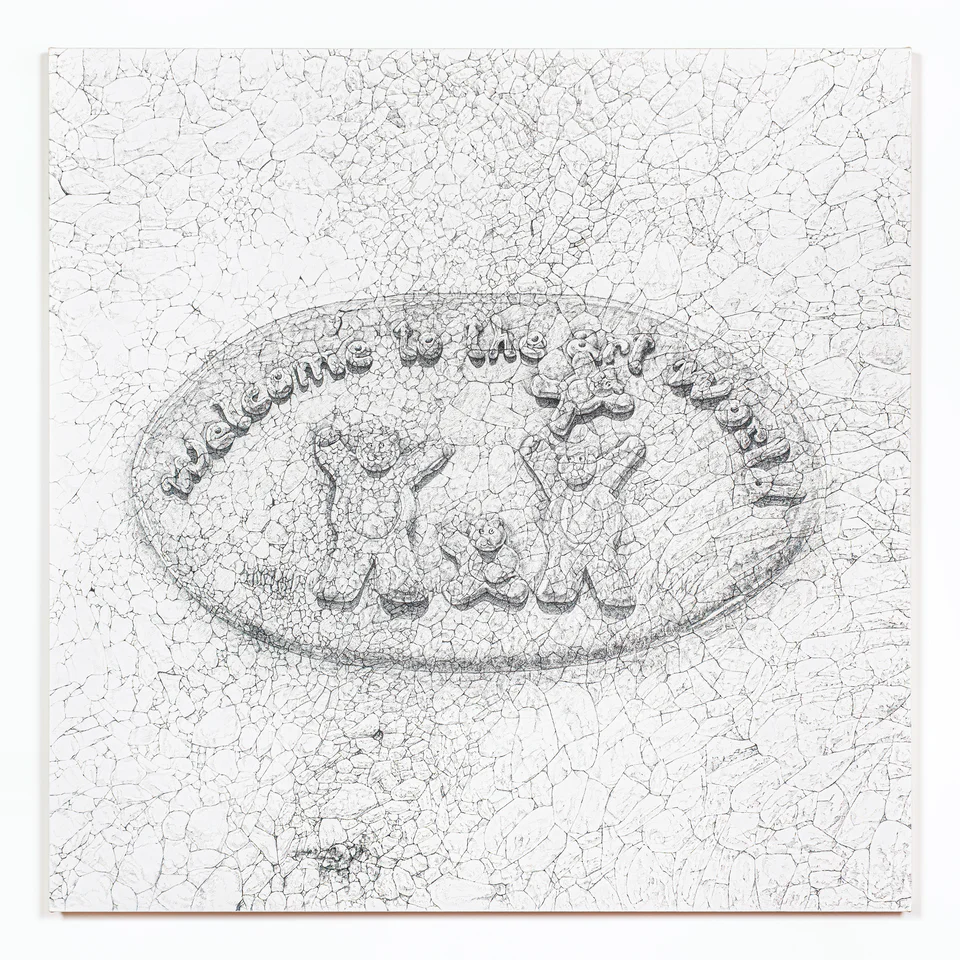
‘I had the idea of painting it myself: in a way, to possess it.’
– Welcome to the Art World
external – Jacques Rancière (2000) asks how seeing and speaking are shared out among people. An inscription makes an object readable; its support, its use and its owner still decide who encounters it, and on what terms.
external – In Martha Rosler’s Semiotics of the Kitchen (1975), kitchen utensils enter an alphabet of gestures. I read that change between an object and a sign beside the plates, bowls and borrowed words here: a familiar thing carries a language, and its use can change what that language allows.
Plate 1, Alfredo Aceto. found – he long promised me one of his ceramics and never gave it, so I painted it myself; Greffes thanks him too: ‘…Alfredo Aceto had long promised to exchange or give me one of his ceramics…’ (Welcome to the Art World); ‘Special thanks to Alfredo Aceto…’ (Greffes)
inferred – Continue through Concealment and interfaces, Painting as an object, Instructions and scores. These plates share this reading; each work keeps its own source and dates.
20 Study and transmission
Study passes through exercises, conversations, exhibitions and works. In 2015 I showed in Life is a Bed of Roses, (un roman), curated by Stéphanie Moisdon, and took my Master of Arts in Fine Arts at ECAL. The works and the ways of thinking developed together. A format can carry that learning further: a book gathers material, a plate puts it beside other material, an instruction leaves someone else a way to act. P+ continues a method of making many possible projects. Transmission is also a change of hands, in which another person can interpret what has been passed on.

external – For Irit Rogoff (2008) education is a turn in what people can think and do together. These two entries mark moments of study; they do not draw a line of descent.
external – Stéphanie Moisdon curated Life is a Bed of Roses, (un roman). Her book with Les presses du réel gathers criticism, interviews and exhibition texts. It belongs on this plate for that one credit, and I keep it to that.
Plate 5, #aaafff. inferred – in 2013 I entered Stéphanie Moisdon’s programme and built the first #aaafff frames; the Chronology sets them side by side and leaves you to weigh what one owes the other: “…in the programme directed by Stéphanie Moisdon.” (Chronology); “I built wooden frames for the first #aaafff paintings…” (Chronology)
inferred – Continue through History as organisation, Instructions and scores, Working together. These plates share this reading; each work keeps its own source and dates.
21 Instructions and scores
An instruction gives a work a possible action and leaves room for an interpretation. P+ I asks for drafts of ideas mixed together; the cards carry prospects that can be rearranged before they are realised. This belongs to a longer history than conceptual art. In 1920 Tzara gave a recipe for a Dada poem: cut up a newspaper article, shake the words in a bag, copy them out in the order they come. From Buenos Aires, Duchamp sent his sister Suzanne and Jean Crotti a wedding present as an instruction: hang a geometry book outside and let the weather take it apart. Moholy-Nagy said he ordered his enamel pictures of 1923 by telephone. The scores came after: George Brecht’s Water Yam (1963), which gives P+ VI its name; Yoko Ono’s Grapefruit (1964) and Alison Knowles’s Make a Salad (1962), where an imagined or ordinary action becomes the work’s occasion; and Sol LeWitt, in 1967, putting the idea before its execution. I keep the rule and its possible uses together. The same question returns in labels, contracts and exhibition proposals: what can a few words set in motion?
‘It is a toolbox, a database stemming from a theoretical strategy first meant for teaching: to sketch 100 projects a week.’
– P+
‘Never produce a finished object or work; only write and imagine drafts of ideas, mixing them together.’
– P+ I
external – Sol LeWitt (1967) wrote that in conceptual art all the planning and decisions are made beforehand, and the execution is a perfunctory affair. P+ keeps the planning and leaves out the execution: the cards stay open to the next combination.
external – Yoko Ono’s Grapefruit (1964) gathers instructions that can be enacted or completed in the imagination. The written proposal is already a form to handle and pass on. I set it beside P+ I, where the draft stays open to several actions and arrangements.
external – Alison Knowles’s Make a Salad (1962) makes an ordinary action available as a score. A few words can organise movement, sound and a shared occasion. Here an instruction, a label and a contract offer ways to pass an action from one person to another.
external – e-flux keeps an archive of unrealised projects as material in their own right. I take it as a comparison for how a project lives on; it gives me no rule for deciding which cards are works.
inferred – Continue through Labels and classification, Study and transmission, Contracts and circulation. These plates share this reading; each work keeps its own source and dates.
22 Institutions and their voices
Museums speak through names, logos, labels, displays and the roles they give people. Museum borrows Marvel’s language of exceptional figures; Beware of Curator turns the guardian of cultural heritage into a warning sign. I use these familiar forms to ask who authorises a voice, what an institution makes visible and how a work can redirect the language around it. Institutional critique enters the work through an image, a phrase or a performed role. The sign remains recognisable, while its use opens a question about the authority it carries.
‘Marvel, on the face of it a product of popular culture, answers a primal human need: stories, heroes, figures larger than life who cross difficult moral ground and are supposed to rise above it.’
– Museum (Fraser Official Welcome)
external – Andrea Fraser (2005) counts the critic as part of the institution: whoever criticises it also has a stake in it. That includes me, painting these signs from inside the field they address.
external – Robert Smithson (1972): Beware of Curator names his essay ‘Cultural Confinement’ as its reference. Setting it beside Museum is my arrangement for this plate.
inferred – Continue through Labels and classification, Typography and appropriation, Contracts and circulation. These plates share this reading; each work keeps its own source and dates.
23 Contracts and circulation
A contract can give a work an action, a recipient and a way to circulate. Matthieu Laurette’s two-line contracts allow expenses to be acquired; DEMANDS & SUPPLIES made that financial structure visible as an exhibition and an online shop. I connect this to instructions and scores: a small written form can organise a larger sequence of acts. A label describes a work, an instruction proposes what to do, and a contract addresses an exchange. The different forms let me look at what passes between an artist, a collector, an institution and a public.
“Matthieu Laurette is proposing since 2012, through a commercial arrangement, simple two-line contracts that allow his expenses to be acquired.”
– DEMANDS & SUPPLIES
“It presents a full financial disclosure of all costs and expenses incurred in the past eight years of Matthieu Laurette’s practice as an artist.”
– DEMANDS & SUPPLIES
external – The agreement of Seth Siegelaub and Robert Projansky (1971) keeps some of the artist’s rights in force after a sale. Laurette’s contract does something else; set side by side, the two show what a contract can hand over and what it holds back.
external – Laurette discloses all his costs and expenses of the past eight years. Benjamin H. D. Buchloh (1990) read conceptual art as an aesthetic of administration, and Siegelaub disputed his account. The form of a contract does not tell me whether a work reproduces an institution, redirects it or criticises it.
inferred – Continue through Labels and classification, Communication and distance, Instructions and scores. These plates share this reading; each work keeps its own source and dates.
24 Working together
Working together changes the authorship and the relations inside a work. For Greffes, Christophe de Rohan Chabot and I showed two #aaafff-covered boxes, each referring to the other as its twin. Tournures brought Grichka Commaret and Kim Farkas into one exhibition; a + o – was a shared artistic and curatorial practice with Nastassia Cougoulat Montel. A common format can hold distinct decisions. The work includes the tasks of arranging, discussing, showing and keeping things going, as well as the object or image that remains visible.
‘I began a + o –, a collaborative artistic and curatorial practice with Nastassia Cougoulat Montel, active until 2015.’
– Chronology
external – The 1969 manifesto of Mierle Laderman Ukeles made maintenance, the daily work of keeping people and things going, into art. A photograph of an installation shows the work and leaves out the work of keeping it up.
external – For John Roberts (2010) losing a skill and learning a new one are social processes. A decision of mine still relies on other people’s work.
external – The e-flux journal issue of Elena Vogman and Matteo Pasquinelli asks how art operates through labour, cooperation and automation, beyond the objects that represent it. It is a current question, and I leave it open.
inferred – Continue through History as organisation, Making an archive live, Study and transmission. These plates share this reading; each work keeps its own source and dates.
Continue with the Curriculum Vitæ, the Biography, the Chronology, Relations, Bibliography & Press or the Index.